About Blumea balsamifera (L.) DC.
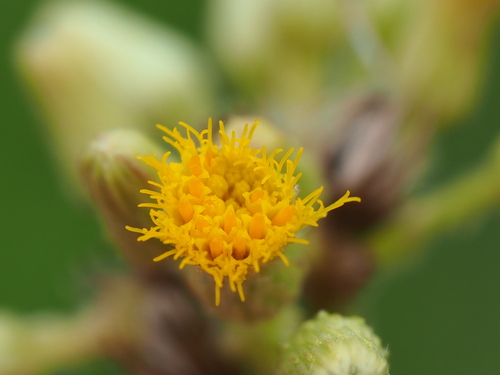
Blumea balsamifera (L.) DC. is most widely known by its common name sambong in the Philippines. In Filipino traditional herbal medicine, it is used for the common cold and as a diuretic. It is also used to treat infected wounds, respiratory infections, and stomach pains in Thai and Chinese folk medicine. The genus Blumea grows in the tropical and subtropical zones of Asia, particularly the Indian subcontinent and Southeast Asia, and Blumea balsamifera is one species of this genus used throughout Southeast Asia. This plant is a ruderal weed that commonly grows on disturbed land and in grasslands. Physically, it is a softly hairy, half woody, strongly aromatic shrub that reaches 1 to 4 meters in height. It has simple, alternate, broadly elongated leaves 7 to 20 cm long, with toothed margins and appendaged or divided bases. Loose yellow flower heads are scattered along much-branched leafy panicles. It produces two types of discoid flowers: small, numerous peripheral flowers with tubular corollas, and few large central flowers with campanulate corollas. Anther cells have tails at their base. Its fruit, an achene, is dry, 1-seeded, 10-ribbed, and hairy at the top. In most regions of the Philippines, this species is called sambong (pronounced sahm-BOHNG with pure vowels) in Tagalog; in the Visayas it is known as bukadkad or gabon, and in Ilocos it is sometimes called subusob, subsub, or sobsob. Its primary uses are as a diuretic, or water pill, and to relieve symptoms of the common cold. As a diuretic, sambong is used to treat urolithiasis (urinary tract or kidney stones) and urinary tract infections, and as a result can reduce high blood pressure. It functions as an expectorant, antidiarrheal, and antispasmodic, all of which address common cold symptoms. It is also sometimes used as an astringent for wounds. This use is approved by the Philippine Department of Health’s Institute of Traditional and Alternative Health Care, and by the Bureau of Plant Industries of the Department of Agriculture. No responsible practitioner claims that Blumea balsamifera cures the common cold or kidney disease, and it carries the note "No Approved Therapeutic Claims"; the only legitimate recognized claim is that it relieves symptoms. Active compounds are found in the volatile oil extracted from its leaves. This oil is composed mostly of camphor and limonene, with trace amounts of borneol, saponin, sesquiterpene, and tannin. Sambong is commercially available as a tea, which has a woody taste with a hint of menthol. An official Government of the Philippines website describes the tea as having "a strong camphoraceous odor and a pungent taste." Outside of the Philippines, Blumea balsamifera has additional regional uses across Asia. In Thai folk medicine, it is called Naat (หนาด), reputed to ward off spirits, and used to treat infections. It is also used in traditional Chinese medicine, Malay folk medicine, and Indian Ayurvedic medicine. Beyond medicinal uses, it can be used as a decorative dry plant. The Bodo community of Assam, India, uses it as a flavorful herb, adding it to soups, chicken, and curries, and serves it as a side dish with chillies and the local native soda ash water called khardwi.