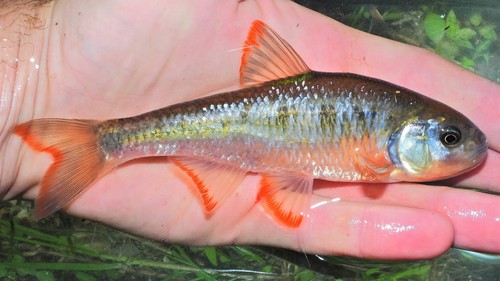
About Blicca bjoerkna (Linnaeus, 1758)
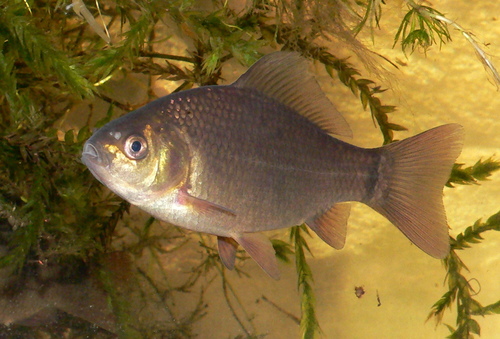
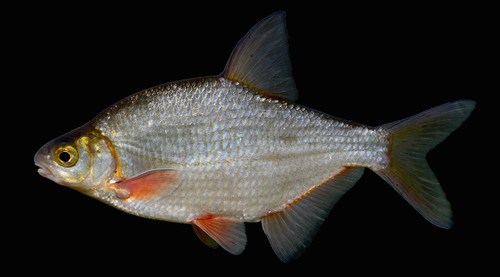
Blicca bjoerkna, commonly called silver bream, closely resembles immature common (bronze) bream Abramis brama in overall appearance, but can be told apart by its larger scales. The most reliable first step to identify the species is counting scale rows from the front of the dorsal fin to the lateral line, including the lateral line scale. Bronze bream have 13 or more scales in this count, while silver bream have 9 to 11. Silver bream have a lateral line scale count of 44 to 49, while bronze bream have a count of 49 and above, usually well over 50. Larger specimens are much easier to distinguish, due to clear differences in color and body shape. By the time both species reach sexual maturity, they are relatively easy to tell apart. Silver bream scales stay a bright, highly reflective silver color throughout their entire lives, while bronze bream scales develop a range of hues from dark brown to light ochre yellow. However, some bronze bream remain silver their whole lives, depending on their habitat. Confusion commonly occurs when sexually mature silver bream and sexually immature bronze bream are compared quickly in the field. Bronze bream grow to the size of sexually mature silver bream very quickly while still young, and are almost always silver themselves at this stage. The maximum weight silver bream reach varies based on habitat quality, but in optimal conditions it can reach 1.6 kg (3 lb 8 oz). In normal conditions, most silver bream never exceed 0.45 kg (1 lb), and in small ponds they do not even reach 0.3 kg (11 oz). There are subtle differences in body shape between male and female silver bream. Females are less compressed than males, have a rounder overall form, are a little deeper bodied, and often have a pronounced chest bulge. Males are slimmer, far more compressed, lack the chest bulge, and may only be two-thirds as wide as a female of the same length, so they often weigh considerably less. Males have quite pointed heads with a slightly upturned snout, while females have rounder heads with a snub nose. During the breeding season, males become covered in tubercles, often develop a reddish flush on their bellies, and have intense vermilion coloration on their pectoral and ventral fins; all other fins may become very dark and opaque. At the same time, females become very rotund and deep set. Compared to the size of its head, the silver bream has a very large eye. This characteristic distinguishes it from bronze bream, and from all other European Leuciscidae family fish except bleak. The silver bream's eye is round and protruding, with a yellowish cornea and black iris. The length of the head from the tip of the snout to the far edge of the gill plate is around four times the eye diameter, and head depth is over twice this value, regardless of the fish's age. In bronze bream, the relationship between eye size and head length changes significantly over the fish's lifetime. It starts with ratios similar to silver bream, but in fully grown bronze bream, head length can be as much as six to seven times the eye width, and head depth four to five times. These measurements are taken along lines that bisect the eye in both directions. The silver bream's eye is also set very close to the end of the snout and close to the top of the head, a pattern that is much less pronounced in bronze bream. Silver bream have light pink to vermilion pectoral and ventral fins. Their anal fin, deeply forked caudal fin, and dorsal fin are all transparent grey to dark grey. The anal fin has 21–23 branched rays. Silver bream rarely have mucus on their bodies, and only carry a small amount if any is present. In contrast, bronze bream are often very slimy, especially when young. Blicca bjoerkna is distributed across most of Europe and adjacent Western Asia. Its natural distribution excludes peripheral areas such as northern Sweden, northern Finland, Norway, most of the British Isles (only excluding Southern England), and most of the Iberian and Italian peninsulas. Introduced populations are present in Spain and Italy. In Asia, it is found in the Caspian Sea and Aral Sea basins, and in Anatolian Black Sea drainages.