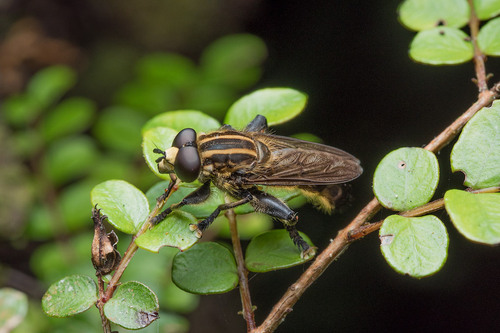
About Blera scitula (Williston, 1882)
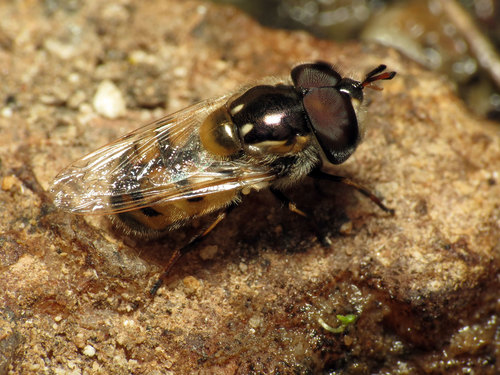
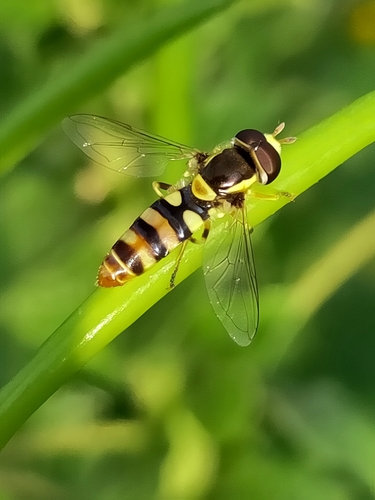
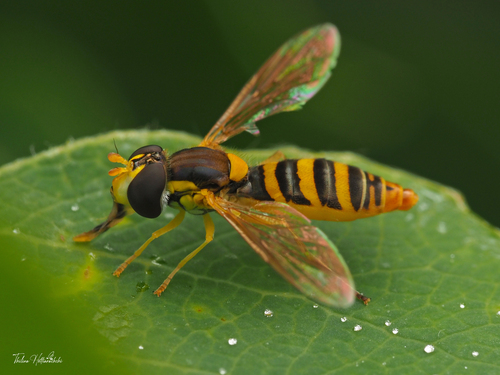
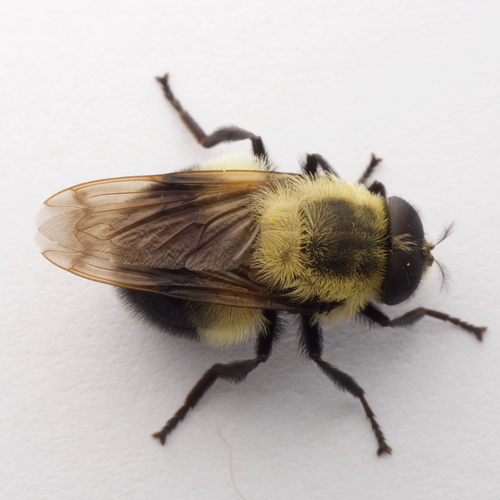
For explanation of anatomical terms, see Morphology of Diptera. External images are available. This species measures 10 to 13 mm in size. Head: The frontal triangle is opaque yellow. The vertical triangle is black and covered with black pile. In females, the frons is moderately narrowed toward the top, yellow on its lower fourth, and shining greenish black across the rest, except for thin reddish pollinosity in front of the ocelli. The frons is covered in black pile; the pile is longer on the ocellar triangle, and yellow at the vertex. The face is yellow, covered with yellow pollen, and has a prominent rounded tubercle in the center. The gena are shining black. The antennae are red, with the flagellum showing faint brownish coloring on the upper side. The arista is brown. The frontal prominence is yellow, with sparse, short yellowish pile along its side margins and lower sides. In males, the eyes are contiguous (holoptic). The occiput is greyish yellow pollinose, covered with bright yellow pile. Thorax: The thorax dorsum (scutum) is aeneous, with bright yellow pile located before the transverse suture, along the narrow lateral margins, and immediately in front of the scutellum. The humeri (postpronotum) and scutum border are yellow. The disc area behind the suture is black. In females, there is a patch of black pile before the ends of the thoracic suture. The scutellum is aeneous, covered with long bright yellow pile, though some black hairs are present on the disc. Abdomen: The abdomen is black with prominent yellow markings. The second abdominal segment has a pair of large yellow spots, rounded on the inner side and directed forward laterally, so the spots reach the anterior margin toward the sides. The third segment has a broad, complete basal yellow band (fascia) that occupies at least half, and sometimes four-fifths, of the segment length on each side of the median notch. The band narrows considerably or moderately toward the sides, and never extends over the side margins for more than half the segment length, and sometimes only narrowly at the anterior angles. The fourth segment is variable: it is sometimes entirely black, but most often has a triangular spot on the anterior angles and a pair of narrowly separated triangular spots in the middle at the base that are reddish yellow. Sometimes all these markings may be more or less fused, while the central black stripe (vitta) is usually distinct. The fifth abdominal segment is yellowish at the base, more broadly so in the middle. The abdominal pile is slightly shorter across the entire abdomen. In females, the abdominal bands are narrower; the second and third segments are usually narrowly interrupted in the middle, the fifth segment is yellowish basally (more broadly so in the middle), and the pile is slightly shorter across the entire abdomen. The hypopygium is usually reddish. The genitalia of this species were described by Metcalf in 1921. Wings: The wings are cinereous hyaline, and somewhat yellowish on the anterior basal portion. The squamae (calypters) are white, with a yellow border and fringe. The halteres are yellow. Vein R4+5 is almost straight and joins the costa just before the tip of the wing. The first posterior cell r4+5 is acute at the apex and extends almost to the wing margin before the wing tip. This is a Nearctic species found in the western coastal area of North America.