About Blera confusa Johnson, 1913
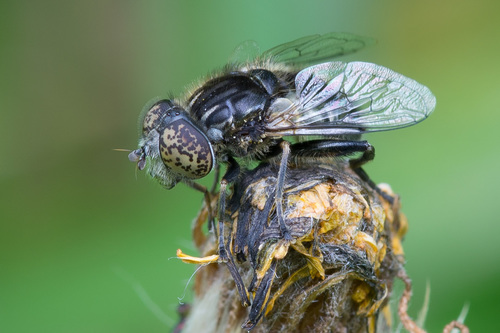
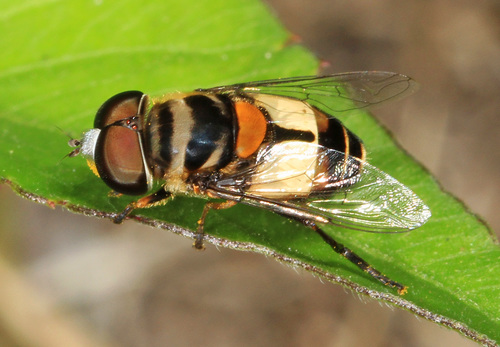
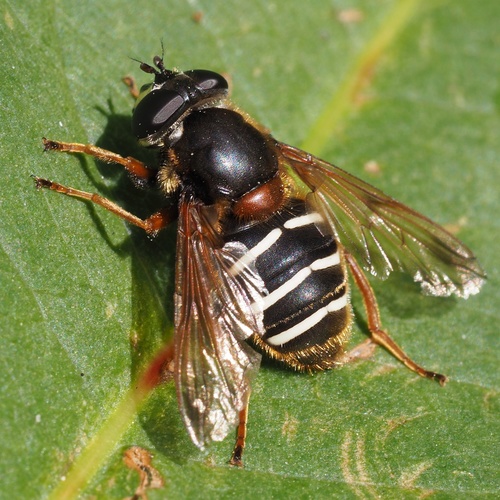
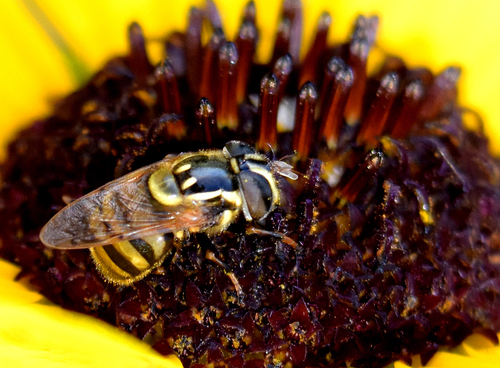
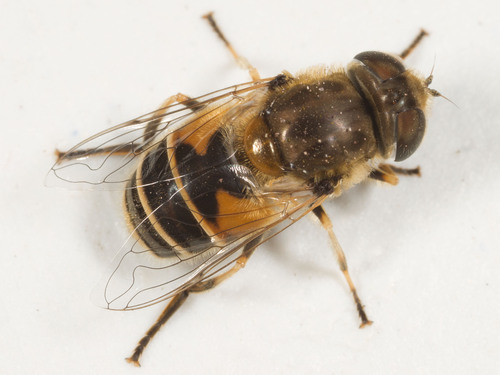
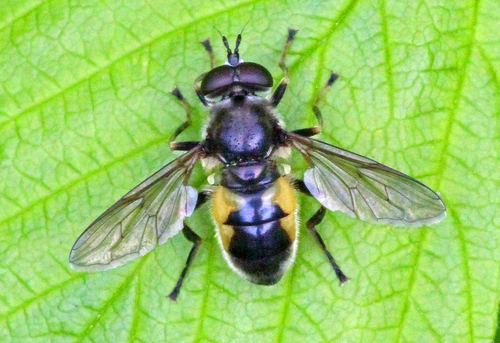
For terminology related to this description, please see Morphology of Diptera. The body length of Blera confusa is 10 mm. For the head, the vertical triangle and antennal process are black. The frons is black, covered in a shining surface with a thin layer of grayish pollen and whitish hairs. The face is yellow and covered with yellowish pollen, with a wide black facial stripe (vitta) running beneath the antennal process. The gena are shining black. The scape and pedicel of the antenna are black, while the flagellum and arista are brown. The occiput is black, covered with thick grayish pollen and white pile. The thorax is greenish black and shining, covered with long dull yellowish pile. The humeri (postpronotum) are covered with grayish pollen. The abdomen is black with yellow spots located on its anterior portion. The first abdominal segment is entirely black. The sides of the second segment bear large yellow triangles that connect to smaller yellow triangles on the third segment. The black area on the dorsum of these segments has an hourglass shape. The yellow triangles on the third segment are approximately half the size of those on the second segment. The fourth segment has small to inconspicuous yellow triangles at its anterior angles. The abdominal pile is yellowish, except on the black areas of the second and third segments, where the pile is black. In female individuals, the yellow abdominal triangles on the third abdominal segment are much smaller. The wings are brownish hyaline with brown veins. The R4+5 vein is almost straight, and joins the costa (C) just before the tip of the wing. The first posterior cell (r4+5) is acute at its apex, and extends almost to the wing margin before the wing tip. The halteres are yellow. The legs are patterned black and yellow. The front, mid, and hind femora are all black. The front and mid tibiae are yellow, with wide black rings on their lower half. The hind tibia is black. The front and mid tarsi are mostly yellow, with the last two tarsomeres black. The hind tarsi are entirely black. Blera confusa is a Nearctic species that is widely distributed across Eastern and Central North America.