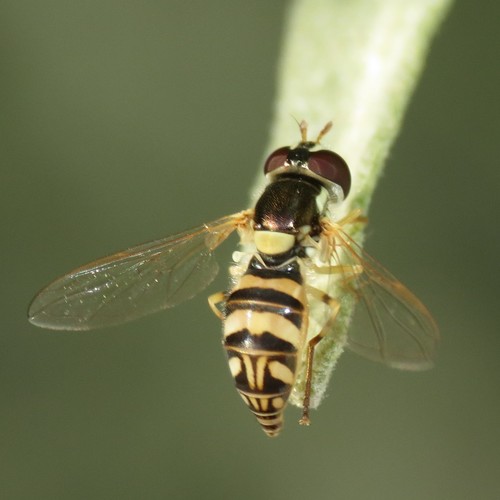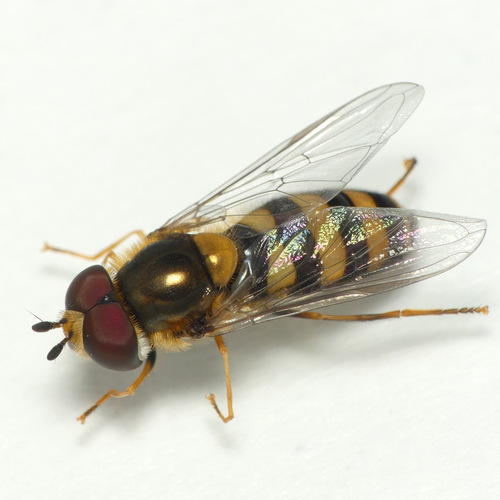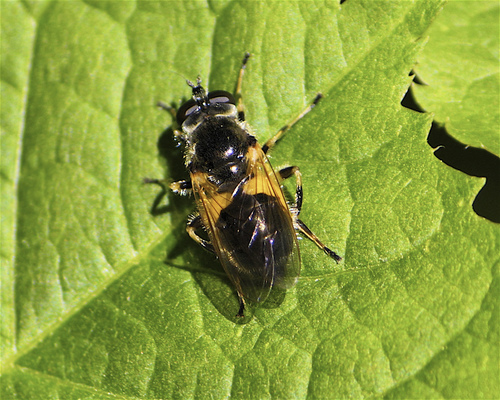
About Blera badia (Walker, 1849)
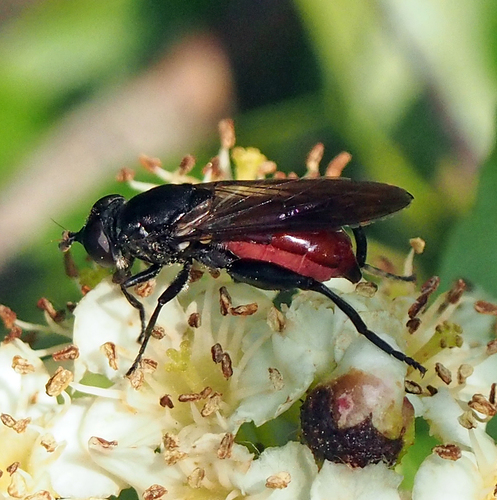
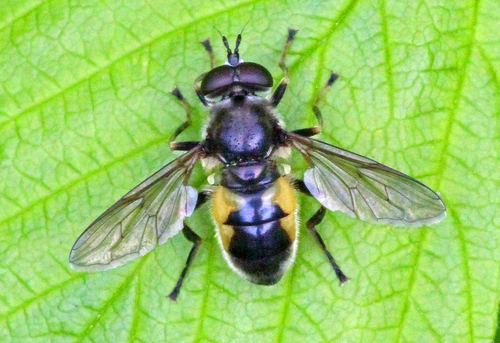
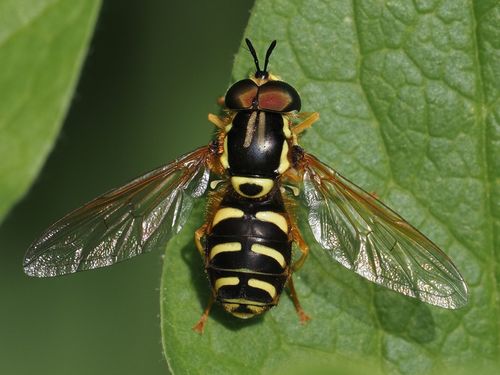
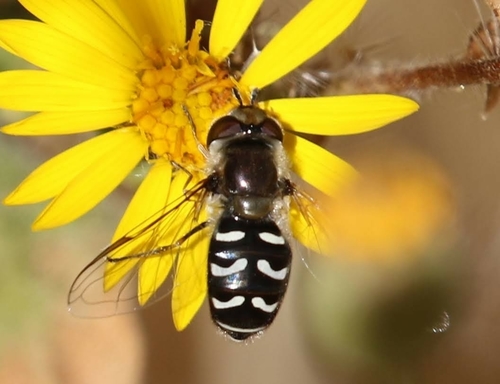
For terminology used in this description, please refer to Morphology of Diptera. This species measures 10 to 11 mm in body length. Head: The frontal triangle is black and shining, with dusting near the orbits. The face is yellowish white and thickly covered with silvery dust. A medial shining black stripe (vitta) runs from just below the antennae to the oral cavity. The gena is shining black from near the eye to the oral opening. The antennae are black; the flagellum is more brown, and the arista is brown. The occiput is black, has whitish pile, and is thickly covered with grayish dust. Thorax: The thorax and postpronotum are greenish-black and shining, covered with rather long dusky pile. Pile is more abundant and whitish on the pleurae. Abdomen: The abdomen is a deep shining greenish-black, with short erect black pile; on the sides and the last segment, the pile is longer and yellowish white. The second segment has large yellow triangles on its sides that extend across the full length of the segment, and these triangles continue along the side of the third segment—narrowly in males, more broadly in females. The triangles are covered with abundant yellow pile. The genitalia were described by Metcalf in 1921. Wing: Vein R4+5 is almost straight and joins the costa (C) just before the wing tip. The first posterior cell (r4+5) is acute at its apical end and extends almost to the wing margin before the tip. Legs: The legs are patterned black and yellow, with pile that is black or yellow to match the leg's color. The front femur is black, except the tips at both joints are yellow. The front tibia is yellow with a black ring near the tarsi. The front tarsi are pale yellow, except the last three tarsomeres are black. Middle legs are similar in description to the front legs. The hind femur is mostly yellow except for a wide black preapical ring. The hind tibia is black with yellow coloring at the joints. The hind tarsi are yellow, with the last three tarsomeres black. Distribution: Blera badia is a Nearctic species that is widely distributed in Eastern and Central North America.