About Blepsias cirrhosus (Pallas, 1814)
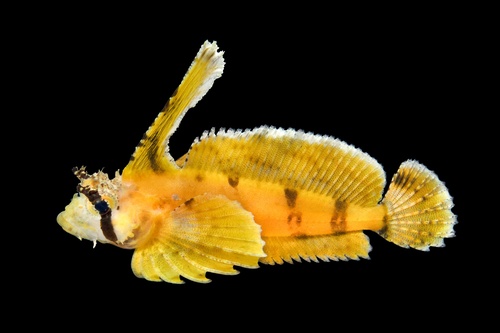
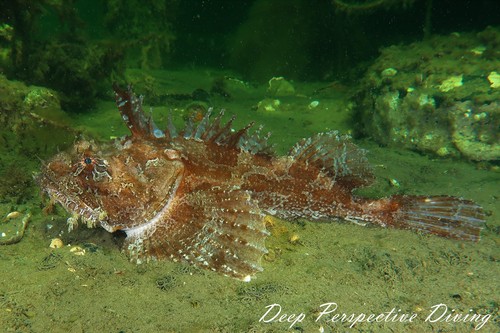
Blepsias cirrhosus has a deep, compressed body covered in papillae. Each papilla encloses a small spine that is embedded in a bony plate within the skin. The fish has cirrhi on its chin. Its first dorsal fin is notched, while the second dorsal fin and anal fin are large and positioned opposite one another. The dorsal fin has between 6 and 9 spines and 20 to 25 soft rays, and the anal fin has 18 to 21 soft rays. The pectoral fin holds between 11 and 13 rays, and the small pelvic fin has 3 soft rays. The caudal fin is rounded. The upper body is brownish to greenish with dark blotches on the back, and the ventral side fades to reddish or yellowish. There are white spots on the flanks near the pectoral fin, and the fins are brown or black with large clear patches. The maximum published standard length of this species is 20 cm (7.9 in).
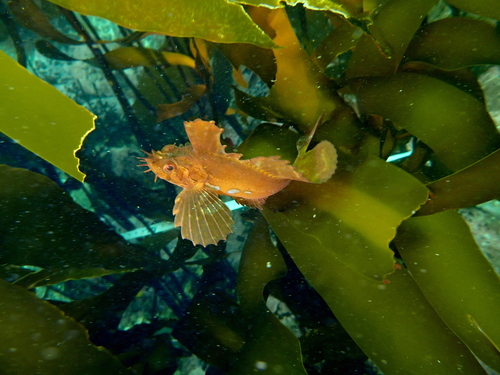
Blepsias cirrhosus occurs in the North Pacific Ocean, with a distribution ranging from the Sea of Japan north to the Bering Sea, and south along the western coast of North America as far as San Simeon in central California. It is a demersal fish that lives at depths between 0 and 150 m (0 to 492 ft), found in intertidal zones and more commonly in subtidal areas, typically no deeper than 37 m (121 ft). It is frequently found among algae.