About Blattella germanica (Linnaeus, 1767)
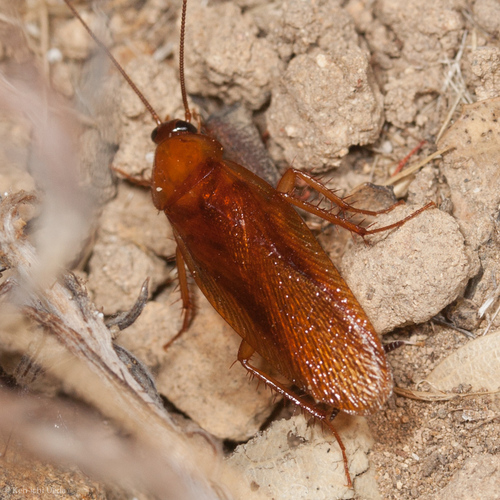
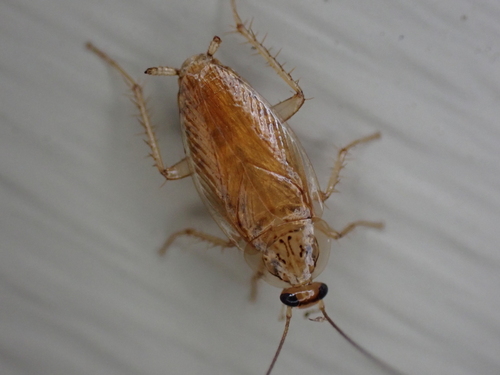
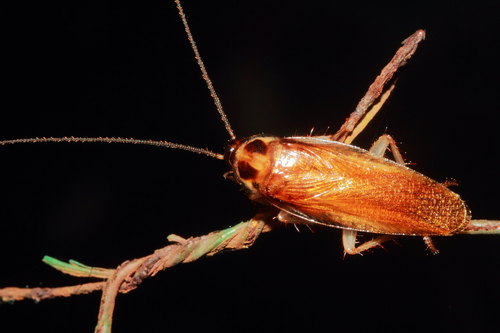
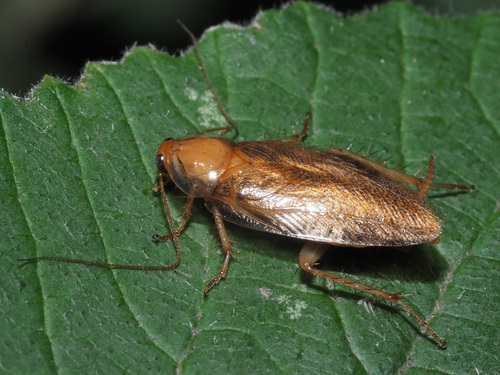
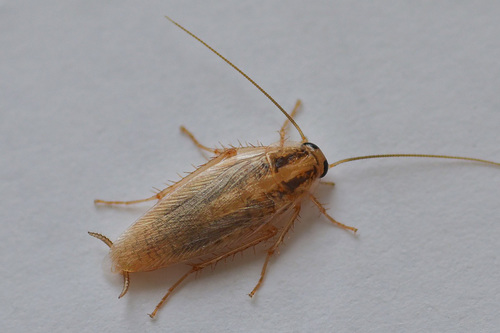
The German cockroach, scientifically named Blattella germanica, is also commonly called the croton bug. It is a small cockroach species, usually measuring 1.1 to 1.6 cm (0.43 to 0.63 in) long. Its body color ranges from tan to almost black, and it has two dark, roughly parallel streaks on the pronotum that run anteroposteriorly, from behind the head to the base of the wings. Though B. germanica has wings, it can barely fly, but it may glide when it is disturbed. Among the small number of cockroach species that act as domestic pests, this is likely the most widely troublesome one. It is very closely related to the Asian cockroach, and the two look nearly identical to a casual observer, so they are often mistaken for one another.
German cockroaches reproduce faster than any other residential cockroach species. Under ideal conditions, they grow from egg to reproductive adult in roughly 50 to 60 days. Females are rounder and shorter, while males are typically longer, narrower, and lighter in color. After fertilization, a female German cockroach develops an ootheca in her abdomen. The abdomen swells as the eggs develop, until the translucent tip of the ootheca begins to protrude from the end of the abdomen. By this stage, the eggs inside are fully grown, and the ootheca is about 1⁄4 inch (6.4 mm) long with 16 segments. The ootheca is translucent at first, soon turns white, then becomes pink within a few hours, and progressively darkens until it reaches a dark chestnut-shell red-brown around 48 hours after formation. It has a keel-like ridge along the line where nymphs emerge, and curls slightly toward this edge as it finishes maturing. A small percentage of nymphs may hatch while the ootheca is still attached to the female, but the majority emerge around 24 hours after the ootheca detaches from the female's body. Newly hatched nymphs are 3 mm long and black, and go through six or seven instars before reaching sexual maturity. The molting process (ecdysis) is dangerous, and nearly half of all nymphs die of natural causes before reaching adulthood. Living nymphs that are present during molting will quickly eat the molted skins and dead nymphs.