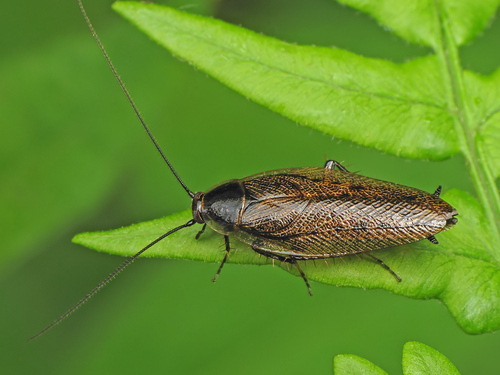
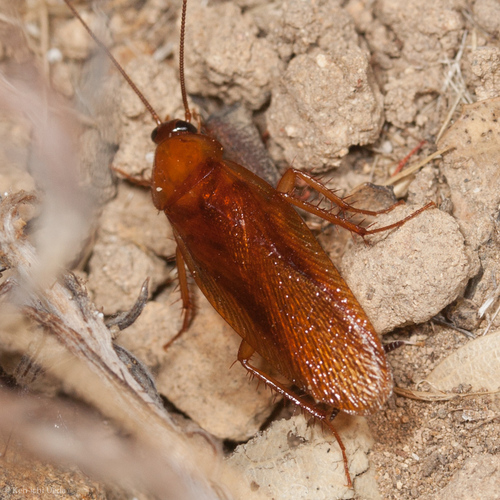
About Blattella asahinai Mizukubo, 1981
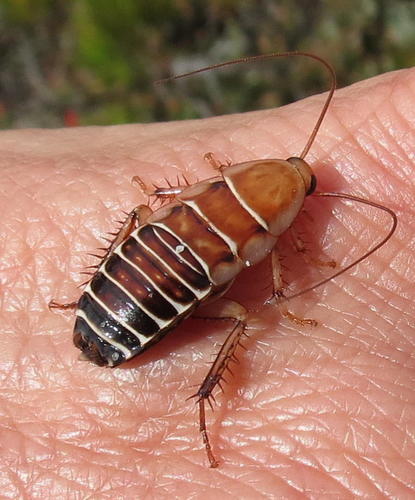
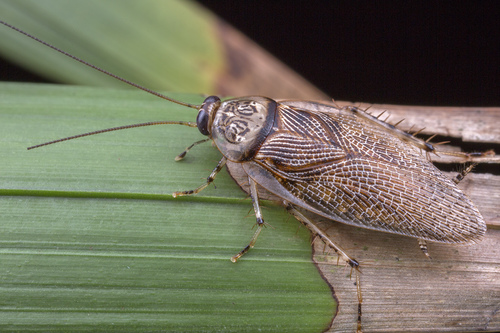
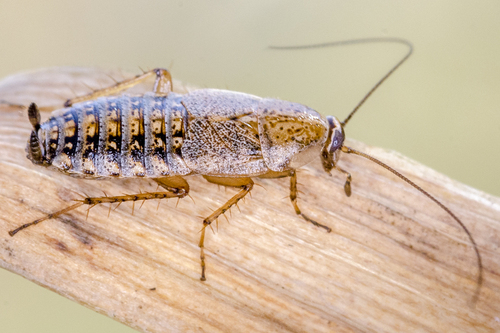
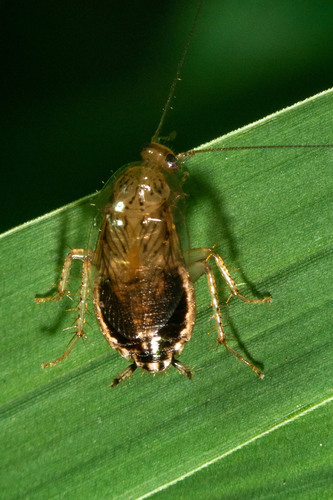
The Asian cockroach, Blattella asahinai, is nearly identical in appearance to the closely related German cockroach (B. germanica), with only a few minor morphological differences between the two. Like the German cockroach, the Asian cockroach is about 1.6 cm (5⁄8 in) long, tan to brown in color, and has wings. Its wings are longer than those of the German cockroach, and the two species differ in the shape of a groove on the abdomen. More obvious differences between the two are that the Asian cockroach is a strong flier attracted to light, while the German cockroach is not, and Asian cockroaches typically prefer outdoor habitats while German cockroaches prefer indoor spaces. Their nearly identical appearance creates challenges for the pest management industry when developing control strategies, as pesticides effective against German cockroaches are not always effective against Asian cockroaches. Visible morphological differences that distinguish the two species can be found on the ventral surface of the left mandible, the vein coloration of the right tegmen, wing size and venation, and the setal marginal bristles on the cerci. Due to their extreme similarity to German cockroaches, the Asian cockroach was only formally recognized as a distinct species in 1981 by Dr. Takayuki Mizukubo of Japan's National Institute of Agro-Environmental Sciences. Recent genetic analysis shows that German cockroaches diverged from Asian cockroaches just over 2000 years ago, which is thought to be when German cockroaches spread to areas where they no longer came into contact with Asian cockroaches. The first recorded introduction of Asian cockroaches to the United States was in 1986 in Lakeland, Florida, where the insects were initially misidentified as German cockroaches. It is thought that Asian cockroaches arrived in Florida via imported goods from Japan. On March 3, 1986, Dr. Louis M. Roth received Lakeland, Florida cockroach specimens from Dr. Philip G. Koehler of the University of Florida Florida Extension Services for examination. A pest control worker had already noted these insects were referred to as German cockroaches but could fly well and were common outdoors, as only two Blattella species (the field cockroach B. vaga and the German cockroach) were known to occur in the U.S. at the time. Though Roth had not previously known of the Asian cockroach species, he identified it and sent multiple Lakeland specimens to Dr. Mizukubo, who confirmed they were B. asahinai. In September 2007, the Center for Urban and Structural Entomology at Texas A&M University conducted ethological, morphological, and genetic testing to confirm the presence of Asian cockroaches in Harris County, Texas. DNA sequence evaluations confirmed the species' similarity to the German cockroach, and found that environmental factors play a significant role in distinguishing the two species even with only minor morphological differences. Asian cockroaches were first confirmed in Harris County, Texas in May 2006 around Barker Reservoir, found in both urban and undeveloped areas, and were later also documented in the Hunter's Creek subdivision in the greater Houston area. Since their introduction to Florida, Asian cockroaches have spread across most of Florida and into other southern U.S. states including Alabama, Georgia, South Carolina, and Texas. In 2003, agents from the Alabama Cooperative Extension System in Dothan, Alabama received multiple reports of "flying German cockroaches"; after obtaining specimens and comparing a male specimen to descriptions from Dr. Mizukubo and Dr. Roth, they confirmed the specimens were in fact Asian cockroaches. Asian cockroaches live predominantly outdoors in shaded, mulched or composted areas where fresh plant litter accumulates, and in damp areas. They favor large areas of grass or leaf litter. When a habitat is suitable, Asian cockroaches become the dominant cockroach species there and can form populations ranging from 30,000 to 250,000 cockroaches per acre (74,000 to 618,000 per hectare). Their populations peak in late August and decline quickly once cool weather begins. Asian cockroaches are most active at dusk and are attracted to light-colored surfaces and bright lights. They may fly toward homes at dusk and enter through open doors and windows, but large indoor infestations are rare. While other cockroach species are known to carry disease-causing bacteria, current research has not found that Asian cockroaches carry any pathogens or diseases. However, they may come into contact with other bacteria due to their outdoor habitats near areas with outdoor pathogens, animal feces, and fungi. Ecologically, Asian cockroaches are more similar to field cockroaches than German cockroaches, as both Asian and field cockroaches breed outdoors. Like female German cockroaches, female Asian cockroaches carry their egg capsules (oothecae) with them until the eggs hatch. Compared to German cockroaches, female Asian cockroaches produce fewer oothecae over their lifetime, an average of around four, with each ootheca holding 35 to 40 eggs. Asian cockroaches have longer initial and subsequent pre-oviposition periods than German cockroaches, and their eggs take slightly longer to hatch. Adult female Asian cockroaches produce their first ootheca approximately 13 days after reaching adulthood, and the period from ootheca formation to hatching is around 19 days. In comparison, female German cockroaches can produce an ootheca around 8 days after reaching adulthood, with an incubation period of approximately 17 days. Asian cockroach oothecae are slightly smaller than those of German cockroaches, and newly hatched first instar Asian cockroaches are noticeably smaller than first instar German cockroaches. Asian cockroaches are most fertile from February to May, and again from August to September. Shortly after hatching, nymphs turn from white to brown and their exoskeleton hardens. Female Asian cockroaches take 60 to 70 days to reach adulthood, which is slightly longer than the development time for male Asian cockroaches. The average lifespan of male Asian cockroaches is around 50 days, while female Asian cockroaches live approximately 100 days; in comparison, German cockroaches have an average lifespan of 130 days for males and 150 days for females. Mating between Asian and German cockroaches is extremely rare due to their behavioral differences, though it can occur. When they do produce viable hybrid offspring, the hybrids are capable of flight and inherit the insecticide resistance found in German cockroaches.