About Blastocerus dichotomus (Illiger, 1815)
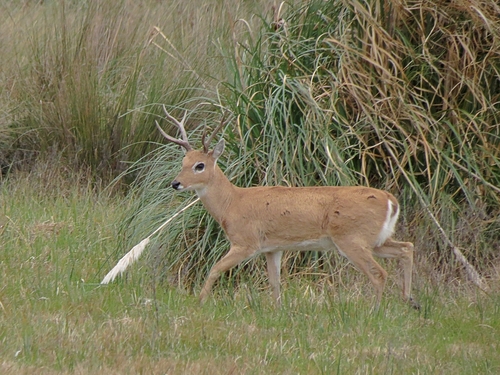
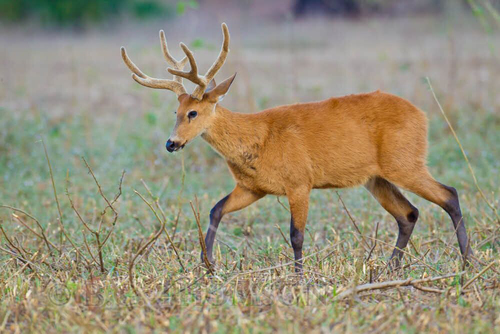
Blastocerus dichotomus, commonly known as the marsh deer, resembles the North American mule deer or blacktail deer in appearance. This species has very large ears lined with white hairs, fur that ranges from red-gold to tawny brown, blackish eyes, and long dark legs. Their coat becomes darker during the winter, and they have white markings on their hips and around their eyes. The lower portion of the legs below the tarsal bone and the muzzle are both black. The upper side of the tail is a paler reddish shade than the rest of the body, while the underside of the tail is black. Marsh deer have a head-and-body length between 153 and 200 cm (5.02 to 6.56 ft), with an additional tail length of 12 to 16 cm (4.7 to 6.3 in). Their shoulder height ranges from 100 to 127 cm (3.28 to 4.17 ft). Their hooves are large relative to their body size, and feature elastic interdigital membranes that help with swimming and walking on marshy surfaces. Only male marsh deer grow antlers, which are branched and can reach up to 60 centimetres (24 in) in length. Most adults weigh between 80 and 125 kg (176 to 276 lb), though occasional large males can reach up to 150 kg (330 lb). This makes the marsh deer the largest living deer species native to South America, though the extinct genus Antifer was larger. The marsh deer is found across Argentina, Bolivia, Peru, Brazil, Uruguay, and Paraguay. Historically, it occupied most of tropical and subtropical South America, with a range that extended east of the Andes, south from the Amazon rainforest, west of the Brazilian Atlantic rainforest, and north of the Argentinian Pampa. Today, most of its population has been reduced to isolated groups in marsh and lagoon zones of the Paraná, Paraguay, Araguaia, and Guaporé river basins. Small populations also exist in the southern Amazon, including in Peru’s protected Bahuaja-Sonene National Park. This species is classified as Vulnerable by the IUCN and is protected under CITES Appendix I. Marsh deer live exclusively in marsh habitats, most notably the Pantanal and Chaco, where water depth is less than 70 cm (28 in) deep. They are strong, swift swimmers. The dense vegetation of their marsh habitats protects them from predators and provides them with food. Marsh deer follow a small seasonal migration pattern, moving with changing water levels between the dry and flood seasons. This movement lets them access new food sources uncovered by receding water during the dry season. Observations of freshwater ponds in Brazil’s Pantanal Wetland found low densities of marsh deer, indicating these small ponds cannot support large populations of the species. Marsh deer are typically solitary, or live in groups of fewer than six individuals that include only one adult male. Their main predators are jaguars and pumas. The breeding rut for marsh deer usually falls during the dry season, though the timing can vary between individuals. Rutting during the dry season is advantageous because marsh deer densities are much higher on the Rio Negro marshland boundary in the dry season, compared to the lower, more dispersed population densities seen during the flooded season, making it easier to find mates. Gestation lasts approximately 271 days. Females usually give birth to a single offspring at a time, though twins occur occasionally. Offspring are typically born between October and November. Infant marsh deer are whitish in color, and develop their adult coat pattern and coloration after one year.