About Blarina brevicauda (Say, 1823)
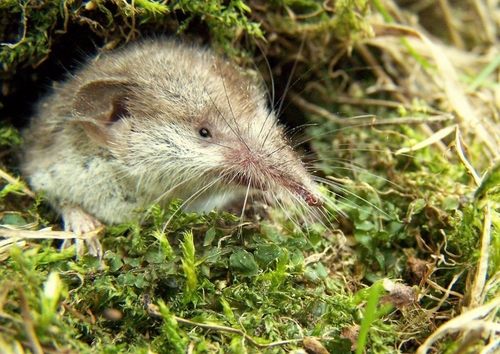
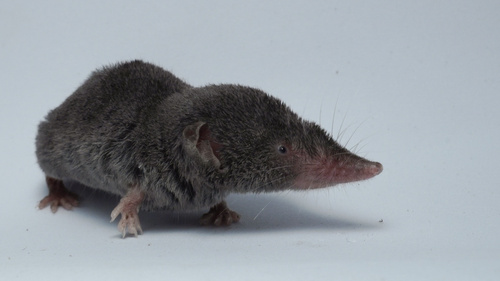
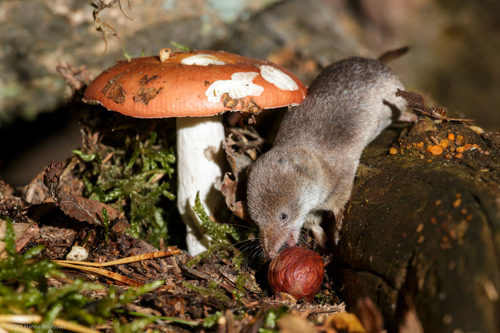
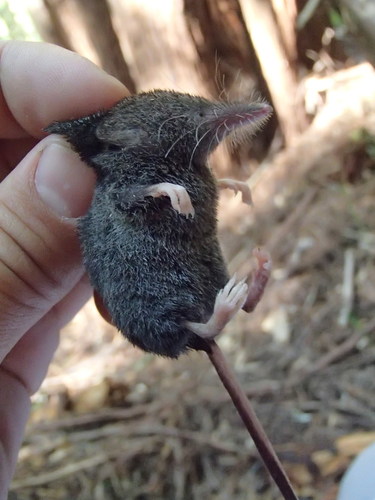
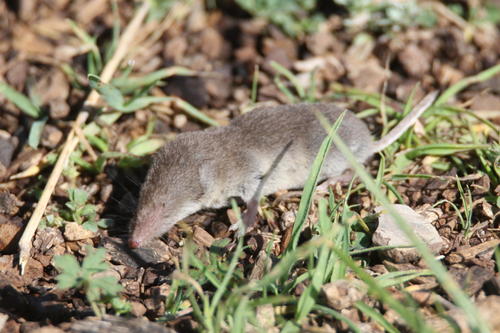
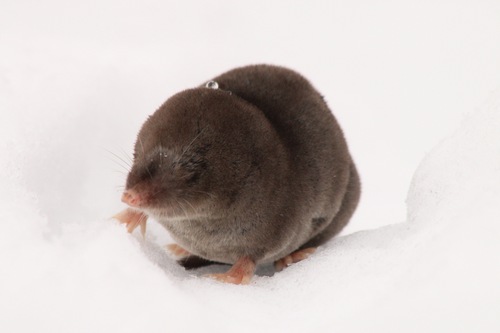
Blarina brevicauda, the northern short-tailed shrew, has a total body length of 108 to 140 mm (4.3 to 5.5 inches), with a tail that makes up 18 to 32 mm (0.71 to 1.26 inches) of that total length. Adults weigh between 15 to 30 g (0.53 to 1.06 oz). This species shows slight sexual dimorphism in size, with males being slightly larger than females. Its thick, velvety dorsal fur can be black, brownish black, or silvery gray, and its ventral fur is lighter and grayer than the dorsal fur. The shrew molts twice a year: it sheds its shorter, paler summer coat for winter pelage in October and November, and molts back to summer fur between February and July. The tail is very short, measuring less than 25% of the shrew’s total body length. Its dental formula is I 3-3/1-1, C 1-1/1-1, P 3-3/1-1, M 3-3/3-3 = 16/16 = 32 total teeth. It has three well-developed scent glands, with one on each side of its body and one on its ventral side. While the scent from these glands may be used to mark territories, the shrew is thought to have a poor sense of smell. This shrew occurs across central and eastern North America, ranging from southern Saskatchewan to Atlantic Canada, and extends south to northern Arkansas and Georgia. It is likely the most common shrew species in the Great Lakes region. Population densities typically range from five to 30 shrews per hectare (two to 12 per acre), and rarely go above 200 shrews per hectare (80 per acre). Individual shrews have a typical home range of 2.5 hectares, and these ranges may overlap slightly with the home ranges of other shrews. Northern short-tailed shrews use both disturbed and undisturbed habitats, including grasslands, old fields, fencerows, marshy areas, deciduous and coniferous forests, and residential household gardens. They prefer moist habitats with leaf litter or thick plant cover. Blarina brevicauda does not quickly recolonize burned-over forests, and shrews leave clear-cuts very quickly. Mating takes place from March through September, though most births happen early or late in this window. Captive male shrews have been observed making clicking sounds while courting females. During copulation, the male and female stay locked together, and the female drags the male along with her. Gestation lasts 21 to 24 days. After birth, females suckle the six to eight young for up to 25 days before weaning. Two litters per breeding season is typical, though three litters are possible. When nursing young, the female strengthens her nest and becomes more active to meet her increased nutritional needs. Young are born hairless and blind, and weigh less than one gram. They can reach sexual maturity in as little as 2 to 3 months: those born in spring mature more quickly than those born late in the season, and may breed themselves in the same year they are born. Juvenile pelage is pale, very similar to adult summer fur, and is molted once the young reach adult size.