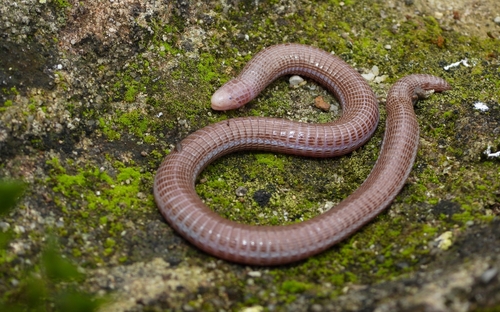
About Blanus cinereus Vandelli, 1797
Blanus cinereus, commonly called the Iberian worm lizard, has a worm-like limbless ringed body, but differs from true worms in several features: it has small underdeveloped eyes, small smooth scales, and all the core traits of a typical vertebrate including a vertebral column, lungs, and a closed circulatory system. Its small blunt head is adapted for digging, with underdeveloped eyes covered by skin, and its characteristic ridged ringed body is covered in scales. Iberian worm lizards have short tails that are covered in the same scales as the rest of the body. They have a small forked tongue used for chemosensory signaling, and a row of small, sharp teeth inside the mouth. Their body color is fleshy-pink, violet, or brown, varying by region. Adults are usually around 150 mm (5.9 in) in total length, and can grow up to 300 mm (12 in) long. They are often mistaken for small snakes or large worms. The Iberian worm lizard is found in Portugal and across most of central and southern Spain. Blanus cinereus is a subterranean species that occurs in a wide range of Mediterranean habitats. Because it lives underground, it is difficult to estimate its population abundance across different regions. Activity studies confirm that the species can survive in habitats located between 400 meters and 1400 meters in elevation. It is a thermoregulator, so it can only survive in habitats that meet its thermoregulatory requirements. Typical habitats for this species have high humus content and scattered rocks of varying thickness. The Iberian worm lizard uses its habitat’s loose soil depth and rocks to help regulate its body temperature. Depending on the time of day, it moves between 0 cm and 10 cm deep in soil and takes shelter underneath rocks that range from 10 cm to 20 cm thick. It uses deeper soil to cool down, and rocks to warm up, adjusting based on time of day and rock thickness. By using habitat features this way, it can maintain a constant body temperature with very low energy cost. There is evidence of chemosensory signaling between the Iberian worm lizard and its environment. This can be observed in how quickly the species burrows into soil to escape predators in familiar versus unfamiliar locations. When predator cues are detected in an unfamiliar location, Blanus cinereus is slower to start burrowing; when returned to its familiar habitat, its burrowing escape response becomes much faster. Precloacal secretions from both male and female Iberian worm lizards contain long-chain waxy carboxylic acid esters. It is thought these secretions are left along the species’ tunnels to help other Iberian worm lizards navigate.

