About Blandfordia nobilis Sm.
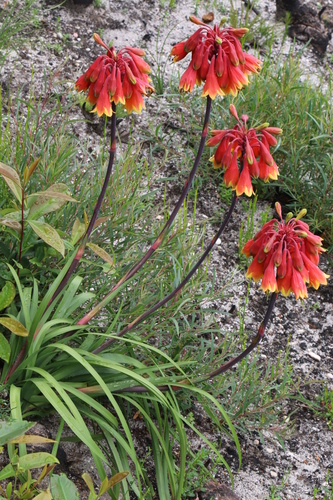
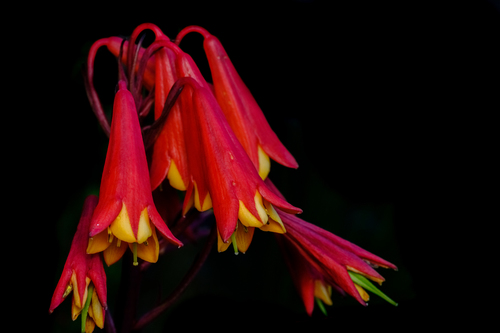
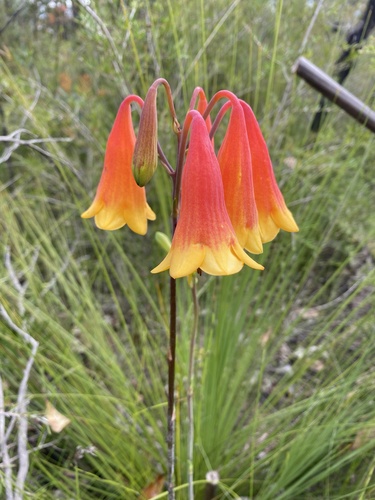
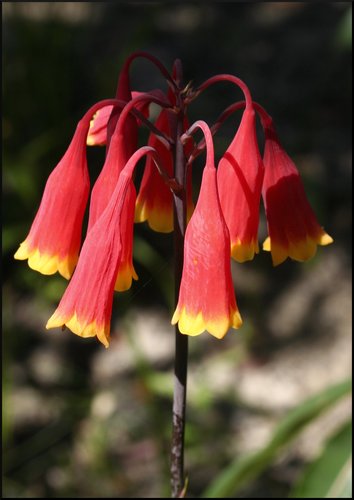
Blandfordia nobilis Sm. has thick, fibrous roots that can form strong, long-lived clumps. Its leaves are stiff and grassy, growing up to 75 cm (30 in) long and 3–5 mm (0.12–0.20 in) wide, and sometimes have small teeth. The unbranched flowering stem reaches up to 80 cm (31 in) long and 6 mm (0.24 in) wide, and bears between three and twenty flowers. Each flower grows on a pedicel stalk up to 35 mm (1.4 in) long, with a small bract near the stalk’s base. The three sepals and three petals are fused to form a cylindrical flower, usually 20–30 mm (0.79–1.2 in) long and about 10 mm (0.39 in) wide. The flower base is narrowed, and the open end has six pointed lobes around 5 mm (0.20 in) long. Flowers are usually brownish red with yellow lobes. Stamens are attached to the inside wall of the flower tube, just below the tube’s middle. Flowering occurs from September to February, peaking in December and January, and is followed by a capsule fruit about 60 mm (2.4 in) long, carried on a stalk up to 25 mm (0.98 in) long. Blandfordia nobilis grows on poor sandstone soils and in swampy areas between the towns of Sydney, Milton and Braidwood. In wet heathland, it grows in association with sundews (Drosera) and Schoenus brevifolius. In horticulture, seeds of B. nobilis were sent to English plant nurseries at around the same time dried specimens were sent to the botanist Smith. However, plants did not flower in cultivation until 1818. It is not clear which species flowered at that time, because at least some plants labeled B. cunninghamii were actually B. nobilis.