About Blandfordia grandiflora R.Br.
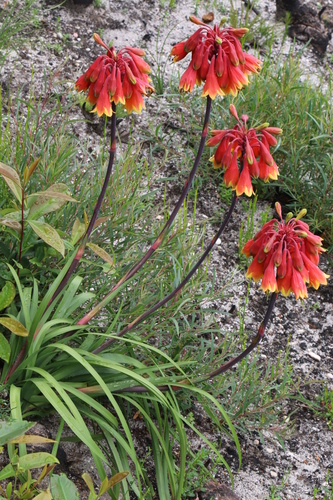
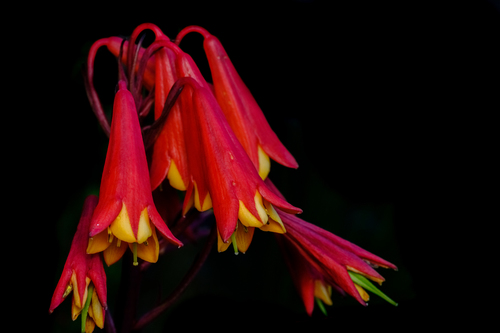
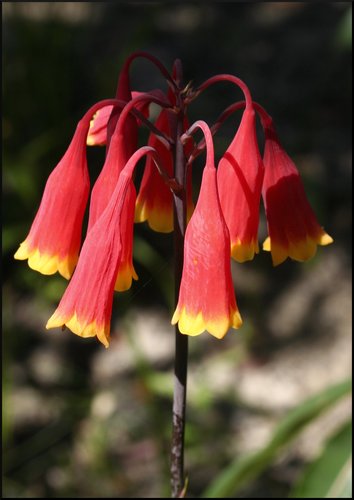
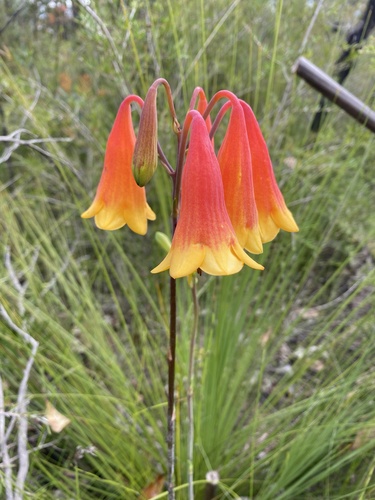
Blandfordia grandiflora R.Br., commonly called Christmas bells, is a tufted perennial plant. It has flat, linear, channelled leaves that usually grow up to 80 cm (31 in) long and 7 mm (0.28 in) wide. Its unbranched flowering stem is usually up to 80 cm (31 in) long and around 7 mm (0.28 in) wide, though it may sometimes reach 175 cm (69 in) in length. Between two and twenty flowers grow on this stem, each borne on a pedicel stalk up to 45 mm (1.8 in) long with a small bract near the stalk’s base. The three sepals and three petals are fused together to form a bell-shaped flower, which is typically 35–60 mm (1.4–2.4 in) long and about 18–30 mm (0.71–1.2 in) wide at its tip. The flower base is narrow, then gradually expands toward the tip, where there are six pointed lobes around 11 mm (0.43 in) long. Flowers are usually red with yellow lobes, but occasionally they are entirely yellow. The stamens attach to the inner wall of the flower tube just below the tube’s middle. Flowering takes place from late spring to early summer, and is followed by a capsular fruit around 60 mm (2.4 in) long, which sits on a stalk up to 60 mm (2.4 in) long. This species grows in damp soils on coasts and tablelands between the Hawkesbury River in New South Wales and Fraser Island in Queensland, and ranges inland as far as Glen Innes. Endemic to Australia, it has a history of cultivation as a potted plant, with many British botanists growing the species in the nineteenth century. It grows well in light, well-drained sandy soils, the type found in the wet coastal heaths of New South Wales and Queensland. It should not be placed in full direct sunlight or heavy shade. It is the most robust of the four known Blandfordia species, but it grows very slowly, so more aggressive plants can easily overwhelm it in its natural wild habitat.