About Blandfordia cunninghamii Lindl.
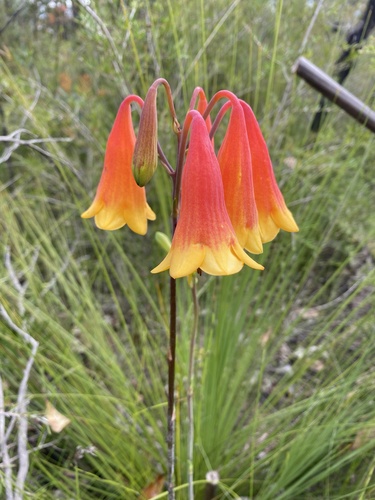
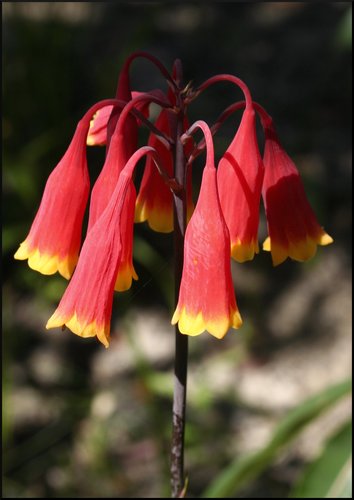
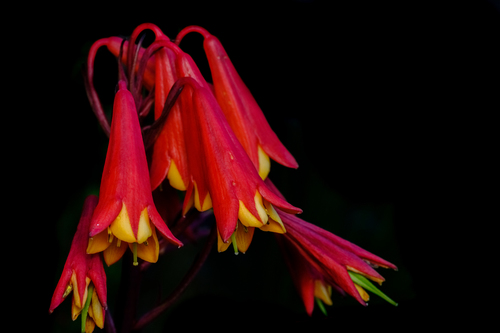
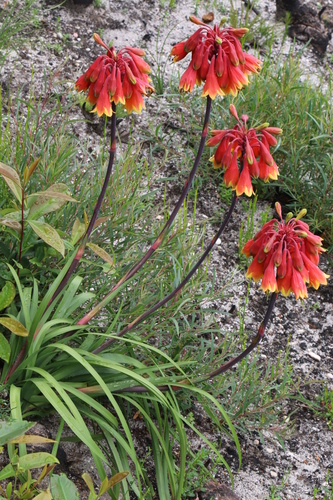
Blandfordia cunninghamii Lindl. is a tufted perennial herb. It has flat, grass-like leaves that grow up to 100 cm (39 in) long, are mostly 7–12 mm (0.28–0.47 in) wide, and sometimes have small teeth. Its unbranched flowering stem reaches up to 80 cm (31 in) long and 10 mm (0.39 in) wide, and bears between twelve and thirty individual flowers. Each flower grows on a pedicel up to 45 mm (1.8 in) long, with a bract of roughly the same length near the base of the pedicel. The three sepals and three petals are fused together to form a cylindrical flower, usually 30–60 mm (1.2–2.4 in) long and 20–30 mm (0.79–1.2 in) wide at the tip. The flower tube is narrower for about one-third of its length, then suddenly expands into a bell-shaped tip. This tip has six pointed lobes that can be up to 12 mm (0.47 in) long. The flower is usually red, with yellow lobes. Stamens are attached to the inner wall of the flower tube, just below the middle of the tube. This species flowers in summer, and after flowering it produces a fruit that is a capsule around 90 mm (3.5 in) long, growing on a stalk up to 40 mm (1.6 in) long. This species of Christmas bells grows in damp, shallow soil, often near cliffs. It is only found in the Blue Mountains and on Mount Kembla in the Illawarra region of New South Wales. Flowering appears to be indirectly stimulated by September rainfall and by bushfire the previous summer.