About Blancoa canescens Lindl.
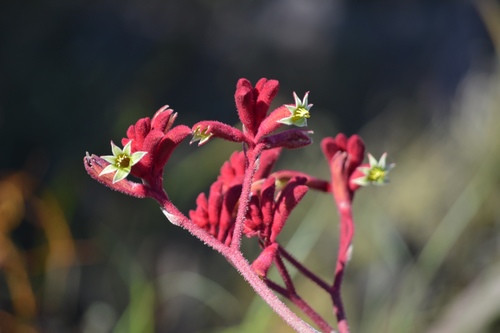
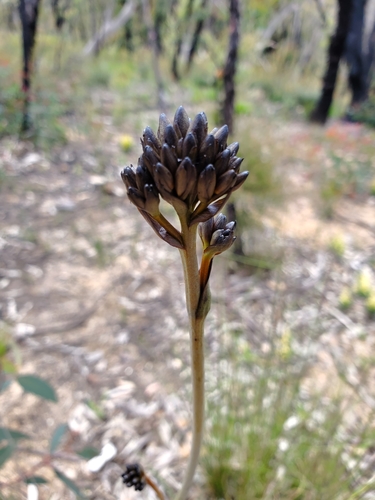
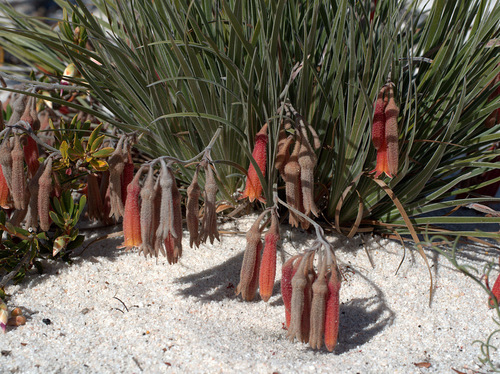
Commonly known as winter bell, Blancoa canescens Lindl. is a clump-forming perennial herb with a rhizomatous rootstock. It produces tufts of linear leaves that measure 25 cm (10 in) long by 0.5 cm (0.2 in) wide, with smooth entire margins and prominent parallel veins. Young leaves are covered in silky hairs. The plant bears nodding pink or red flowers that are around 3 cm (1.2 in) long, with yellowish interiors. Flowers grow in pairs along a short spike that holds only a few flowers. The outside of the tubular flowers is covered in fine rusty-red hairs, while the inside is hairless. Flowering occurs between May and September, during the region's wet season. A nectary at the base of the flower tube produces large amounts of nectar, and the flowers are pollinated by birds. The main pollinators are the singing honeyeater (Gavicalis virescens) and the red wattlebird (Anthochaera carunculata), though other birds and bees may also visit the flowers. Larger birds stand on the ground and reach up into the flowers to sip nectar, while smaller birds hang from the flower pedicel, getting pollen coated on their heads and beaks. After pollination, the flowers fade and wither but stay attached to the plant while the fruits develop inside them. Winter bell is endemic to the coastal strip of southwestern Western Australia, occurring in the Shire of Irwin, the Shire of Gingin, and adjacent areas within the Southwest botanical province. It grows in deep sand in Banksia woodland and in kwongan, an open scrubby heathland community. This region has a Mediterranean-type climate with cool wet winters and hot dry summers.