About Blackstonia perfoliata (L.) Huds.
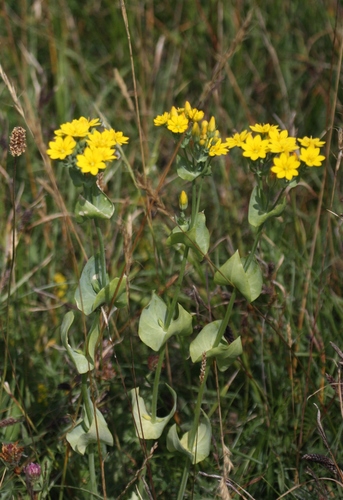
Blackstonia perfoliata, commonly called yellow-wort, grows between 10 and 50 cm (3.9 to 19.7 inches) tall, and has stiff, branching stems. Its leaves are glaucous, grow opposite one another, and have smooth entire margins; upper leaves are perfoliate, meaning their bases are united around the stem. This species produces bright yellow, stalked flowers arranged in terminal cymes; each flower measures 1–1.5 cm (0.39–0.59 inches) across. The calyx is deeply split into 6 to 10 linear sepals or lobes, which are arranged spirally, free or nearly free from each other at the base, and shorter than the corolla. Each flower has 6 to 10 petals that form a short tube, six to ten adherent stamens, and a two-lobed stigma. Ecologically, Blackstonia perfoliata grows in chalk or limestone grassy turf and on sand dunes. In Britain, it flowers from June to October, and it is widespread across the country but not common. One pathogen known to infect this species is Peronospora chlorae.