About Blaberus craniifer Burmeister, 1838
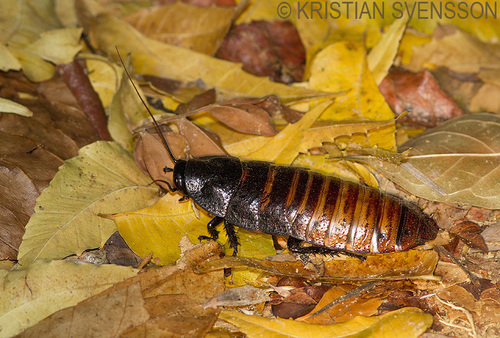
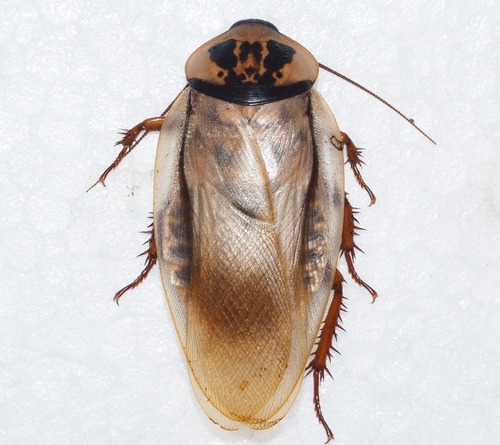
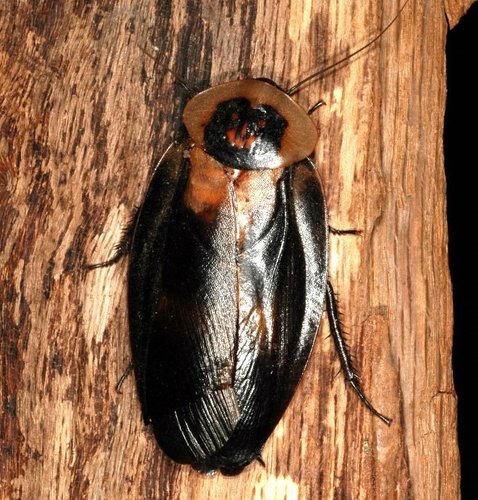
The death's head cockroach (Blaberus craniifer Burmeister, 1838) is a cockroach species in the family Blaberidae. It is frequently confused with the closely related discoid cockroach, Blaberus discoidalis, because of their similar appearance. It can be distinguished by a jet black, cloak-like marking on its wings, and a skull-shaped amber-and-black marking on its pronotum. Its common name "death's head" comes from this pronotal marking; its scientific epithet craniifer combines the Latin crani (meaning "of the head") and fer (meaning "carry" or "carrier"). Thanks to its unique appearance and manageable care requirements, it is commonly kept as a pet or display insect by entomologists and hobbyists. B. craniifer is native to Mexico, the West Indies, and Central America, and has been introduced to southern Florida in the United States. It lives on forest floors, where it hides in leaf litter and rotting wood. B. craniifer is an ovoviviparous species that mates one time per mating event. Mating starts when the female produces a sex pheromone from pygidial glands located on the posterior end of her abdomen, and assumes a calling posture that stimulates the male to move toward her. The male touches the female with his antennae to assess her as a potential mate, then raises his wings and wing sheaths vertically and rotates 180 degrees. The female turns and moves toward the male's abdominal tergites, which secrete a male-specific aphrodisiac sex pheromone. There is a documented close link between the release of these pheromonal signals from specialized glands and the corresponding mating behaviors: female calling posture and male wing raising. While the female licks these male secretions, the male moves backward underneath the female and hooks the edge of her subgenital plate with his phallomere. The female turns 180 degrees, opens her abdominal cavity, and allows the male to insert into her genital atrium. The male forms a spermatophore inside the female's genital atrium, which the female rejects several days later due to secretions from her spermathecal glands. Several days after mating, the female lays an ootheca and holds it inside her brood sac. Gestation lasts between 55 and 65 days. After gestation ends, the ootheca is ejected, and larvae emerge from the embryonic covering. Female sexual receptivity is inhibited both during the preoviposition period and during gestation. Both sexes of B. craniifer have fully developed wings. The most obvious sexual dimorphism is that females have a much larger subgenital plate than males. Unlike many other cockroach species such as Periplaneta americana, B. craniifer does not show sexual dimorphism in antennae.