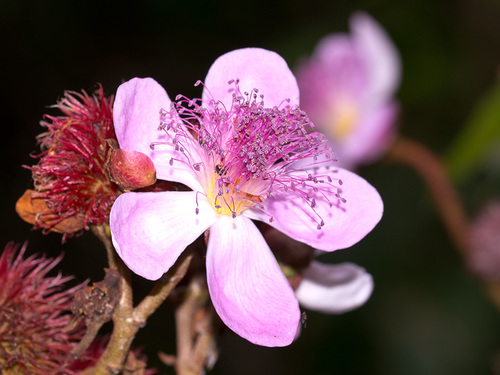
About Bixa orellana L.
Bixa orellana L. is a perennial evergreen, growing from a tall shrub to a small tree that reaches 6–10 m (20–33 ft) in height. It produces clusters of 5 cm (2 in) bright white or pink flowers at branch tips; the flowers have an appearance similar to single wild roses. Its fruits are clustered globular to ovoid capsules, which form spiky red-brown seed pods covered in soft spines. Each pod holds 30–45 cone-shaped seeds, each covered by a thin waxy blood-red aril. When the pod reaches full maturity, it dries, hardens, and splits open to expose its seeds. This species is best known as the source of red-orange annatto pigment, which is obtained from the waxy aril covering Bixa orellana seeds. Annatto dye is rich in carotenoid pigments: 80% of these carotenoids are bixin, the red pigment, with the remainder being norbixin (also called orelline), the yellow pigment. Annatto oil contains tocotrienols, beta-carotene, essential oils, saturated and unsaturated fatty acids, flavonoids, and vitamin C. While the exact origin of Bixa orellana is unknown, it is native to tropical regions of northern South America and Central America. Multiple sources have noted different native ranges for the species: Seemann reported it indigenous to the northwest coast of Mexico and Panama, Triana reported it indigenous to New Granada, Meyer reported it indigenous to Dutch Guiana, and Piso and Claussen reported it indigenous to Brazil. Today, substantial areas of wild and cultivated Bixa orellana grow from Mexico through Ecuador, Brazil, and Bolivia. Although it can act as an invasive species, it is cultivated across many regions of the world. In the 16th and 17th centuries, annatto dye was traded to tropical and subtropical areas of Southeast Asia, Africa, the Caribbean, Hawaii, and southeastern North America, after which it became cultivated in tropical Asian regions including India, Sri Lanka, and Java, primarily to harvest dye from its seeds. Bixa orellana grows easily in subtropical to tropical climates, and requires frost-free areas sheltered from cool winds. It prefers consistent year-round moisture, good drainage, and moderately fertile soil, and can grow in full sun or partial shade. It can be propagated from both seed and cuttings; plants grown from cuttings flower at a younger age than seed-grown seedlings. The main commercial producers of B. orellana are Latin American countries, specifically Peru, Brazil, and Mexico, which together account for 60% of total global production. Africa accounts for 27% of total world production, and Asia accounts for the remaining 12%. Reliable production statistics are not generally available, and do not provide a clear guide to international trade, because most producing countries use a large share of their output domestically. For example, Brazil is both a large producer and consumer of Bixa orellana, and requires additional imports to meet domestic demand. At the start of the 21st century, annual global production of dried annatto seed was estimated at 10,000 tons, with 7,000 tons of this total entering international trade. Peru is the world's largest exporter of annatto seed, shipping around 4,000 tons annually. Brazil is the world's largest producer, with an annual output of around 5,000 tons. Kenya exports roughly 1,500 tons of annatto seed and extracts annually, making it the second-largest exporter after Peru. Côte d'Ivoire, Angola, and the Philippines are also known exporters of the crop. Before synthetic dyes transformed industrial production, Bixa orellana was grown commercially for dye; it is the only plant that produces the pigment bixin. Annatto pigment is extracted from the seed pericarp using alkaline water, vegetable oil, or organic solvents. The annatto pigment has global economic importance, as it is one of the most widely used natural dyes for coloring food, cosmetics, and pharmaceutical products. It is commonly used in foods because its coloring does not change flavor and it is non-toxic, though it may cause allergic reactions in sensitive people. It is most often used to color ice cream, meats, dairy products including cheeses, butter and margarine, and condiments. In cosmetics, it is used in products like lipstick, hair coloring, nail polish, soap, lacquers, and paints. Ground Bixa orellana seeds are often mixed with other seeds or spices to make a paste or powder for culinary use in Latin American, Jamaican, Chamorro, and Filipino cuisines. The seeds are heated in oil or lard to extract their dye and flavor for use in dishes and processed foods including cheese, butter, soup, gravy, sauces, cured meats, and other items. The seeds add a subtle flavor and aroma, along with a yellow to reddish-orange color, to food. A common condiment called sazón, used for meats and fish in Spanish, Latin American, and Caribbean cuisine, is made from ground Bixa orellana seeds, often packaged in small disposable foil packets for convenience, with added cumin, coriander seeds, salt, and garlic powder; the word sazón is Spanish for "season" or "seasoning". On Spanish-speaking Caribbean islands, annatto pigment is also used to make yellow rice, and is sometimes added to sofrito. In the French Caribbean, it is added to a fish or pork stew called blaff. In Brazil, ground Bixa orellana seeds are combined with filler seeds like maize to make a powder called colorau or colorífico, which is similar to paprika and sometimes replaces it. In Nicaragua, achiote (Bixa orellana) is most commonly prepared as a paste, and used in many traditional national dishes, including chancho con yuca, nacatamal, and fritanga. The Yucatecan condiment recado rojo, also called achiote paste, is made from ground Bixa orellana seeds mixed with other spices, and is a staple in Mexican and Belizean cuisines. A major traditional use of Bixa orellana was for body, face, and hair paint among various tribes and ancient civilizations, used either for decoration or as a charm to ward off evil spirits and illness. Groups documented using this plant for this purpose include Brazilian native tribes, the Taíno of Puerto Rico, the Tsáchila of Ecuador, and multiple Amazonian tribes. As a result of the Spanish Conquest, Bixa orellana was introduced to peoples including the Aztecs, Incas, and Mochicas, who later began using the plant. 16th century Aztecs also apparently used annatto pigment as red ink for painting manuscripts. Bixa orellana is used in traditional medicine; in Ayurveda, the folk medicine system of India, different parts of the plant are believed to have therapeutic uses. The plant is also valued for its stem fiber, which is used to make rope and mats, and for its adhesive gum.

