About Biuve fulvipunctata (Baba, 1938)
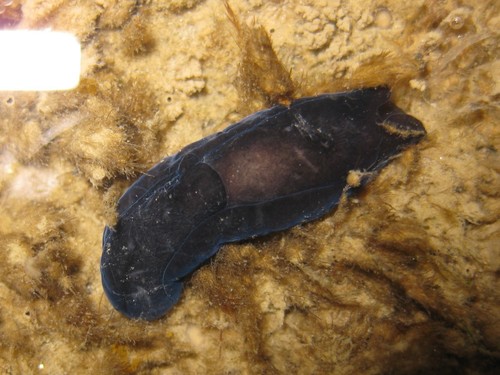
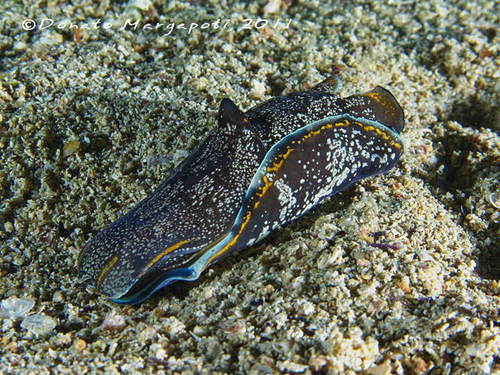
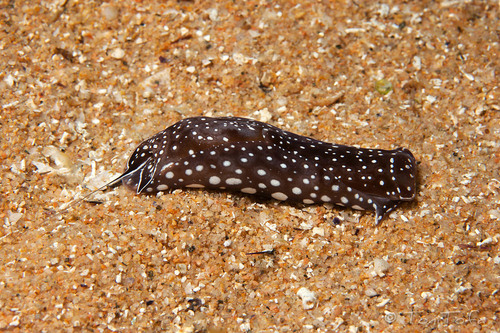
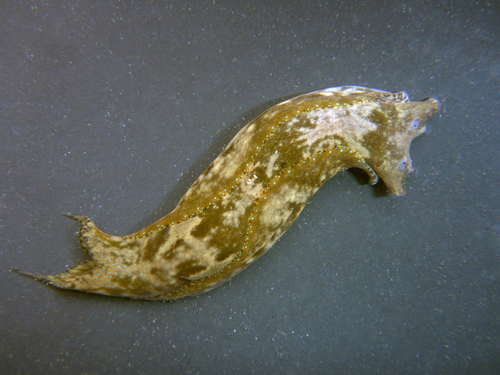
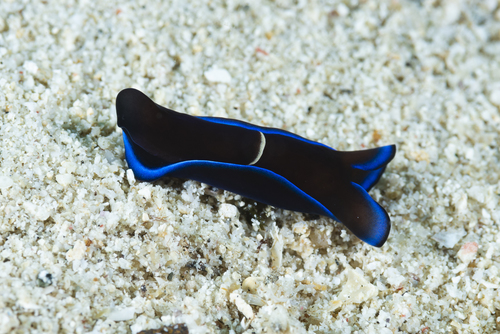
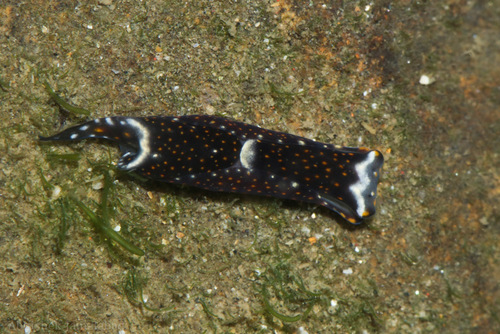
Biuve fulvipunctata is an elongated, somewhat cylindrical gastropod with a very thin internal shell. Its body is split into a cephalic shield and a visceral hump, which is partly covered by a posterior mantle shield. The anterior edge of the cephalic shield is wider than its posterior end, and the shield is roughly divided. The eyes sit at the front of the head, and are almost invisible because they are hidden by the dorsal body surface. On either side of the mouth is a mound covered in sensory bristles. The foot of this gastropod expands into two lateral parapodia, which are long and symmetrical. These parapodia fold over to partially cover the dorsal surface. A pair of tapering lobes extends from the rear of the mantle shield: the left lobe is longer, while the right lobe is much shorter. This species usually has a black or dark brown background body colour with a bluish sheen, marked by yellowish or orange spots. Some specimens are reddish brown with small yellow spots instead. Distinguishing features include a W-shaped white marking across the anterior edge of the head, which may only be partially visible in some specimens, and a white or pale yellow crescent-shaped spot at the posterior edge of the head shield. Adults normally measure 10–20 millimetres (0.39–0.79 in) in length. In Australia, individuals do not normally exceed 18 millimetres (0.71 in), but specimens reaching 33 millimetres (1.3 in) have been recorded in the Mediterranean. Biuve fulvipunctata has a wide distribution. It occurs across the western Pacific, from Mexico and Hawaii westwards to Japan, the east coast of Australia, and Lord Howe Island. It ranges through Indonesia and the tropical Indian Ocean to the Mascarene Islands, Mozambique, and South Africa. It is rare in the Mediterranean, where it was first recorded in 1961 off the coast of Turkey. It has now also been recorded off France, the Balearic Islands, Malta, Cyprus, and Israel. It was first recorded in the Red Sea in 2005. This most likely happened via anti-Lessepsian migration, though it is also possible that B. fulvipunctata entered the Mediterranean from the Red Sea through the Suez Canal. The most likely pathway for B. fulvipunctata to reach the Mediterranean is transport on shipping, as the original Mediterranean discovery site is a former traditional boat building area in southern Turkey that is popular with recreational yacht sailors. It was reported from the Canary Islands in 2016.