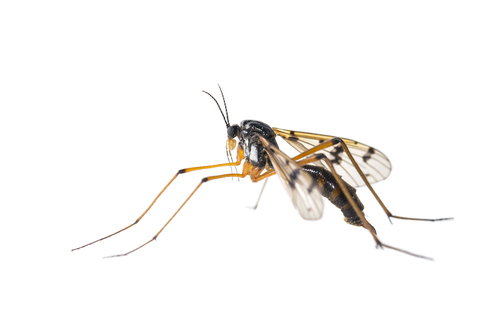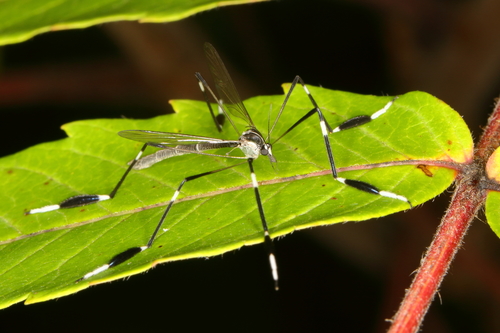
About Bittacomorpha clavipes (Fabricius, 1781)
Bittacomorpha clavipes, commonly known as the Eastern phantom crane fly or Eastern North America crane fly, is a species of phantom crane fly belonging to the family Ptychopteridae. It should not be confused with two other phantom crane fly species: Bittacomorphella jonesi (the pygmy phantom crane fly) and Bittacomorpha occidentalis (the Western phantom crane fly). This species is distributed across Eastern North America, east of the Rocky Mountains. It can be found in fairly dense vegetation along the shady edges of wetlands from late spring to early fall. During reproduction, mating pairs fly while connected in tandem. Mating can occur when both individuals are in flight, or when they are hanging from a leaf. After mating, the female dips the tip of her abdomen into water to deposit eggs, which can number up to 300 total. Eggs are laid either singly or in small groups. Reported incubation duration for eggs is 7 days. Larvae live within the top one inch of wetland substrate, and feed on decaying organic material. They get most of their air through a long, retractable breathing tube that extends from the rear of their body up through the water's surface film. Pupae have a single, greatly elongated spiracular horn that protrudes from their thorax. In the genera Ptychoptera and Bittacomorpha, the right horn is elongated, while in Bittacomorphella, the left horn is elongated. Reported duration of the pupal stage ranges from 5 to 12 days. There is one generation per year across most of its range, and two generations per year in the northern parts of its range.