About Bitis rhinoceros (Schlegel, 1855)
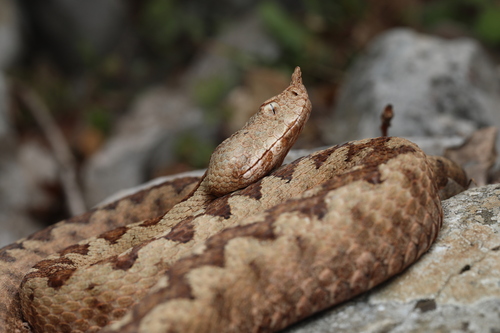
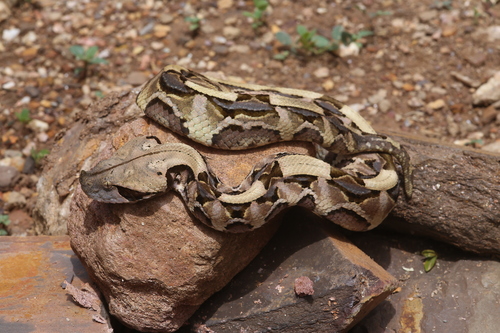
Bitis rhinoceros, first described by Schlegel in 1855, has a distinctive set of enlarged nasal scales that resemble a pair of horns on its nose. It shares this characteristic with its close relative Bitis nasicornis. However, B. nasicornis has a brighter color pattern and a narrower head than B. rhinoceros. Bitis gabonica is generally somewhat smaller overall than B. rhinoceros. Additionally, for the nominal subspecies B. g. gabonica, the dark triangular marking that extends back from the eye toward the angle of the mouth is divided, while this marking is not divided in B. rhinoceros. B. rhinoceros occurs in West Africa, from Togo westward to Guinea, and possibly extends as far west as Guinea-Bissau, including all the intervening countries: Ghana, Ivory Coast, Liberia, and Sierra Leone. Per 1995 research by Spawls and Branch, the eastern edge of this species' range falls around Ghana and Togo, where B. rhinoceros begins to intergrade with B. gabonica. The distribution map they published shows that Togo is generally not included in B. rhinoceros' core range, but at least one specimen has been reported from the country. B. rhinoceros' range now also includes Nigeria; one individual was sighted in 2022 by residents of Ota, a small community in Ogun State, Southwestern Nigeria. Togo, Benin, and at least eastern Ghana make up the larger region called the Dahomey Gap, a relatively dry area that separates the rainforests of West Africa from those of Central Africa.