About Bitis peringueyi (Boulenger, 1888)
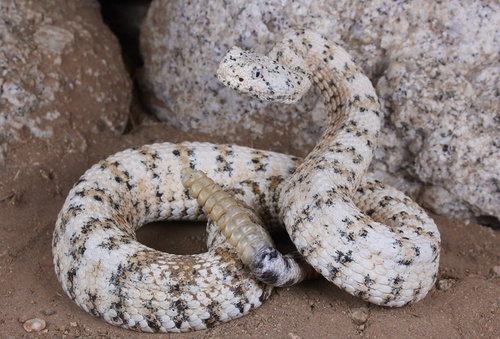
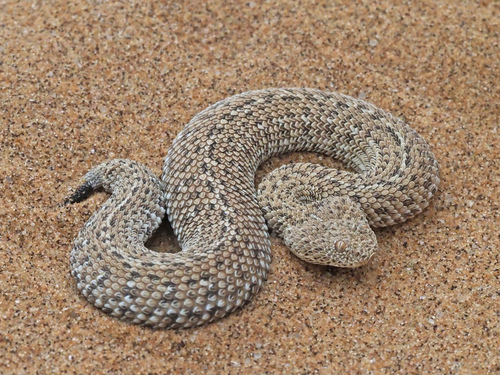
Bitis peringueyi is a small viper species, with an average total length including the tail of 20 to 25 cm (8 to 10 inches), and a maximum recorded total length of 32 cm (13 inches). It has a short, flat head, with eyes positioned on the top of the head. The head is covered in strongly keeled scales, and the smallest scales are found on the anterior portion of the head. Between the two eyes, there are 6 to 9 scales, and each eye is surrounded by 10 to 13 scales. Two to four scales separate the suborbital scales from the supralabial scales. There are 10 to 14 supralabial scales, and 10 to 13 sublabial scales. The single pair of chin shields contacts the first 2 to 4 sublabials. At midbody, there are 23 to 31 dorsal scales, and 21 to 27 on the anterior portion of the body. Almost all dorsal scales are strongly keeled, except for the scales that border the ventral scales; these are large and smooth. There are 117 to 144 ventral scales. The 15 to 30 subcaudal scales are usually keeled, especially toward the tail tip. The anal plate is single. Its base color can be pale buff, chestnut brown to orange-brown, or sandy-grayish, marked with three longitudinal rows of faint, elongated spots that range from gray to dark. The body is also stippled with an irregular pattern of both pale and dark spots. The belly is typically whitish or dirty yellow. The tail is generally tan, but around 25% of specimens have a black tail. This species is found in the Namib region from southern Angola to Lüderitz, Namibia, and has also been recorded in the Fish River Canyon. It also occurs in areas of the Sahara desert, and typically inhabits areas near sand dunes. Its type locality is recorded as "Damaraland, 10 miles east of Walfisch Bay" in Namibia.