About Bitis nasicornis (Shaw & Nodder, 1792)
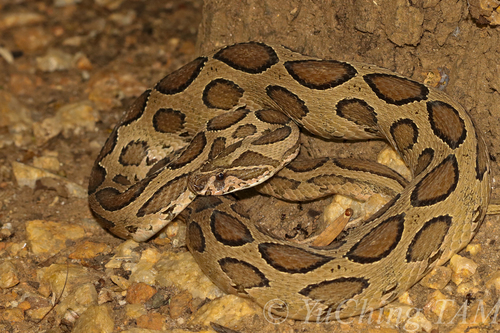
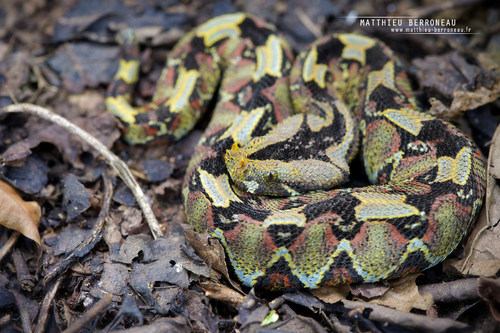
This species, Bitis nasicornis, is large and stout-bodied. Its total combined body and tail length generally ranges from 72 to 107 cm (about 28 to 42 inches). Spawls et al. (2004) note a maximum recorded total length of 120 cm (47 in), though they mention this measurement is exceptional, and give an average total length of 60–90 cm (about 24–35 inches). Explorer Harry Johnston (1858 – 1927) wrote in his 1906 book 'Liberia' that adult individuals of both this species and B. gabonica (the gaboon viper), referred to there as "puff-adders", grow to between four and five feet (about 120 to 150 cm) in Liberia. Johnston also recorded that newborn horned puff-adder young are about a foot (30 cm) long. This birth length is 20 to 65 percent longer than the average 18–25 cm (7–10 in) birth length cited by Spawls et al. (2004). Females of this species grow larger than males. The head is narrow, flat, and triangular, and is relatively small compared to the rest of the body, with a thin neck. The species has a distinctive set of two or three horn-like scales on the tip of the nose; the front pair of these scales may be quite long. Its eyes are small and positioned well forward on the head. The fangs are not large, rarely growing more than 1.5 cm (0.59 in) long. At midbody, there are 31–43 rows of dorsal scales. These scales are extremely rough and heavily keeled, so much so that they can sometimes cut handlers when the snake struggles. There are 117–140 ventral scales, and the anal scale is single. Mallow et al. (2003) reported that subcaudals number between 16 and 32, with males having a higher subcaudal count (25–30) than females (16–19). Spawls et al. (2004) stated there are 12–32 paired subcaudals, and that males have higher subcaudal counts than females. The species' color pattern is made up of a series of 15–18 oblong blue or blue-green markings, each with a lemon-yellow line running down its center. These markings are enclosed within irregular, black, rhombic blotches. A series of dark crimson triangles run down the snake's flanks, narrowly bordered with green or blue. Many of the snake's lateral scales have white tips, which give it a velvety appearance. The top of the head is blue or green, with a distinct black arrow-shaped marking overlaid on it. The belly is dull green to dirty white, with heavy black and gray marbling and blotching. Specimens from western parts of the range are more blue in color, while specimens from eastern areas are more green. After the snake sheds its skin, the bright new coloration fades quickly, as silt from the species' generally moist habitat accumulates on its rough scales. B. nasicornis is distributed from southern Guinea, Sierra Leone, and Liberia to Ghana in West Africa, and through Central Africa in the Central African Republic, southern Sudan, Cameroon, Gabon, Congo, DR Congo, Angola, Rwanda, Uganda, and western Kenya. The species' listed type locality is only given as "interior parts of Africa." It occurs mainly in forested areas, and rarely ventures into open woodlands. Because of this habitat preference, its geographic range is more restricted than that of B. gabonica. Like most vipers, Bitis nasicornis is viviparous, meaning it produces live young instead of laying eggs. In West Africa, this species gives birth to between six and 38 young during March and April, at the start of the rainy season. When born, each neonate has a total length ranging from 18–25 cm (7–10 in) to 1 foot (0.30 m). In eastern Africa, the species has no defined breeding season.