About Bitis gabonica Duméril, Bibron & Duméril, 1854
Adults of Bitis gabonica are typically 125–155 cm (4.10–5.09 ft) in total length, which includes both the body and the tail. A maximum total length of 205 cm (81 in) was often cited for a specimen collected in Sierra Leone, but individuals from that location are now reclassified as Bitis rhinoceros. Sexes can be distinguished by the proportion of the tail relative to total body length: the tail makes up around 12% of total length for males, and 6% for females. Adults, especially females, are very heavy and stout. One measured female had a total length of 174 cm (69 in), a head width of 12 cm (4.7 in), a width or circumference of 37 cm (15 in), and a weight of 8.5 kg (19 lb). In their 2004 description of B. gabonica, Spawls et al. recorded a total length range of 80–130 cm (31.5–51 in), with a confirmed maximum total length of 175 cm (69 in), and noted the species may possibly grow larger. They acknowledge reports of specimens over 1.8 m (5.9 ft), or even over 2 m (6.6 ft) in total length, but state no evidence supports these claims. A large 1.8 m (5.9 ft) total length specimen caught in 1973 was found to weigh 11.3 kg (25 lb) with an empty stomach. This is the heaviest venomous snake in Africa, and one of the heaviest venomous snakes in the world, alongside the king cobra and eastern diamondback rattlesnake.
The head is large and triangular, while the neck is greatly narrowed, at only about one-third the width of the head. A pair of "horns" is present between the raised nostrils, and these horns are tiny in B. gabonica. The eyes are large and moveable, set well forward on the head, and surrounded by 15–21 circumorbital scales. The species has 12–16 interocular scales across the top of the head. Four or five scale rows separate the suboculars and supralabials; there are 13–18 supralabials and 16–22 sublabials. The fangs may reach a length of 55 mm (2.2 in), the longest of any venomous snake. At midbody, the 28–46 dorsal scale rows are strongly keeled except for the outer rows on each side. The lateral scales are slightly oblique. Ventral scales number 124–140; males rarely have more than 132, and females rarely have fewer than 132. There are 17–33 paired subcaudal scales: males have no fewer than 25, and females no more than 23. The anal scale is single.
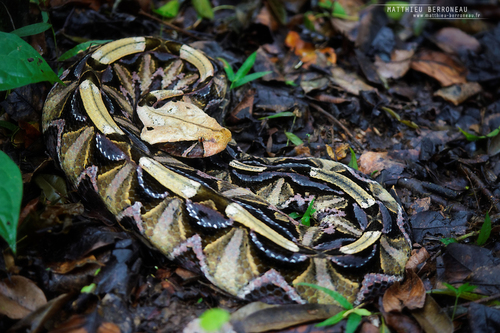
The color pattern is striking when in the open, but in its natural habitat, typically among dead leaves under trees, it provides a high degree of camouflage. In a well-kept cage with a suitable base of dried leaves, it is easy to completely overlook several fully exposed specimens. The pattern consists of a series of pale, subrectangular blotches running down the center of the back, interspersed with dark, yellow-edged hourglass markings. The flanks have a series of fawn or brown rhomboidal shapes, with light vertical central bars. The belly is pale with irregular brown or black blotches. The head is white or cream with a fine, dark central line, black spots on the rear corners, and a dark blue-black triangle behind and below each eye. The iris colour may be cream, yellow-white, orange, or silvery. The Congolese giant toad (Sclerophrys channingi) has been identified as a possible Batesian mimic of the Gaboon viper; this frog species appears to resemble the viper's head, which contrasts with the toad's darker-colored body.
This species is distributed across Guinea, Ghana, Togo, Nigeria, Cameroon, Equatorial Guinea, Gabon, the Republic of the Congo, the Democratic Republic of the Congo, northern Angola, the Central African Republic, South Sudan, Uganda, Kenya, eastern Tanzania, Zambia, Malawi, eastern Zimbabwe, Mozambique, and northeast KwaZulu-Natal Province in South Africa. Mallow et al. (2003) also list Sierra Leone, Senegal, and Liberia in West Africa as part of the species' range. The type locality is given as Gabon, Africa. The Gaboon viper is usually found in rainforests and nearby woodlands, mainly at low altitudes, but sometimes occurs as high as 1500 m above sea level. Spawls et al. (2004) note a maximum recorded altitude of 2100 m. According to Broadley and Cock (1975), it generally occupies environments similar to those of its close relative B. arietans, which is normally found in more open country. In Tanzania, this species occurs in secondary thickets, cashew plantations, and agricultural land under bushes and in thickets. In Uganda, it is found in forests and nearby grasslands. It also thrives in reclaimed forest areas, such as cacao plantations in West Africa and coffee plantations in East Africa. It has been found in evergreen forests in Zambia. In Zimbabwe, it only occurs in high rainfall areas along the forested escarpment in the east of the country. In general, it may also be found in swamps, as well as in still and moving waters. It is commonly found in agricultural areas near forests and on roads at night.
During peak sexual activity, males engage in combat. The interaction starts with one male rubbing his chin along the back of the other male. The second male then raises his head as high as possible. As both males raise their heads, their necks intertwine. When their heads are level, they turn toward each other and push. Their bodies intertwine as they switch positions. They become oblivious to everything around them, continuing combat even after they fall off a surface or into water. Sometimes they intertwine and squeeze so tightly that their scales stand out from the pressure. They have also been observed to strike at each other with closed mouths. Occasionally, the combatants tire and pause the fight by "mutual consent", resting for a while before resuming again. Combat ends when one of the two succeeds in pushing the other's head to the ground and raising its own head by 20–30 cm. In captivity, combat may occur four or five times a week until courtship and copulation are complete. Females can give birth to 50 to 60 live young at a time.