About Bitis arietans Merrem, 1820
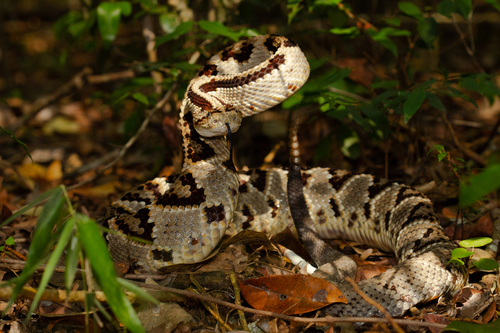
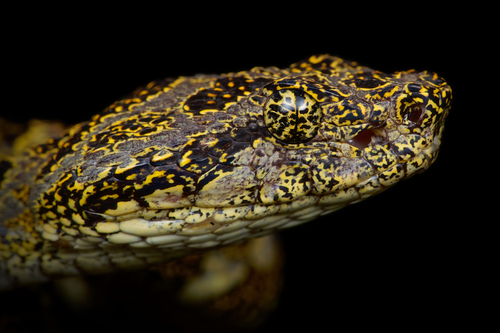
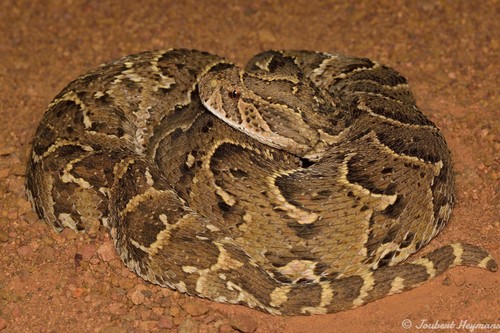
Bitis arietans (commonly known as the puff adder) is typically about 1.0 m (39.3 in) in total body and tail length, with a very stout build. Large recorded specimens reach 190 cm (75 in) in total length, weigh over 6.0 kg (13.2 lb), and have a 40 cm (16 in) girth. Specimens native to Saudi Arabia are smaller, usually no more than 80 cm (31 in) in total length. Males are generally larger than females and have proportionally longer tails. Color patterns vary by geographic location. The head has two distinct dark bands: one across the crown and one between the eyes. On the sides of the head, two oblique dark bands run from each eye to the supralabial scales. The underside of the head is yellowish white with scattered dark blotches. The iris ranges in color from gold to silver-gray. Dorsally, the base body color varies from straw yellow to light brown, orange, or reddish brown, overlaid with a pattern of 18 to 22 backward-facing dark brown to black bands that extend down the back and onto the tail. These bands are most often roughly chevron-shaped, but may be more U-shaped in some regions. They also form 2 to 6 light-and-dark cross-bands on the tail. Some populations are heavily flecked with brown and black, which often obscures other patterning to give the snake a dusty-brown or blackish appearance. The belly is yellow or white, with a small number of scattered dark spots. Newborn young have golden head markings, with pinkish to reddish ventral plates toward the lateral edges. One unusual striped specimen from Summer Pride, East London, South Africa was described by Branch and Farrell in 1988; its pattern consisted of a narrow pale yellowish stripe, one scale wide, that ran from the crown of the head to the tip of the tail. In general, puff adders have relatively muted coloration, the exception being male specimens from highland East Africa and South Africa's Western Cape province, which typically have a striking yellow-and-black color pattern. Puff adders have a form of olfactory crypsis that makes them difficult for scent-based predators including trained dogs and meerkats to detect. The exact mechanism of this ability is unknown, but it is hypothesized to be linked to a low metabolic rate, as well as the snake relocating its position after shedding and defecating. This species may be the most common and widespread snake found in Africa. It occurs across most African regions and in parts of the Arabian Peninsula, and inhabits all habitat types except true deserts, rainforests, and tropical alpine habitats. It is most commonly associated with rocky grasslands. It is not found in rainforest areas such as along the West African coast and in Central Africa, including central DR Congo, and it is also absent from the Mediterranean coastal region of North Africa. On the Arabian Peninsula, its range extends as far north as Ta'if, and it has been reported in the Dhofar region of southern Oman. For reproduction, females produce pheromones to attract males, and competing males engage in neck-wrestling combat dances. One female in Malindi was observed being followed by seven males. Puff adders give birth to large numbers of offspring. Litters of over 80 young have been reported, and litters of 50 to 60 are not unusual. Newborns measure 12.5 to 17.5 cm (4.9 to 6.9 in) in length. Very large specimens, especially those from East Africa, produce the highest number of offspring. A Kenyan female held in a Czech zoo gave birth to 156 young, the largest litter ever recorded for any snake species.