About Bithynia tentaculata (Linnaeus, 1758)
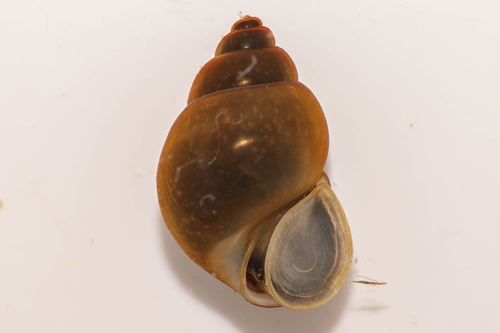
Bithynia tentaculata, commonly called the faucet snail, typically has a shell height between 12 and 15 mm. It reaches sexual maturity once its shell reaches 8 mm in height, and its shell width ranges from 5 to 7 mm. The shell is shiny pale brown, oval-shaped, with a relatively large and rounded spire made of 5 to 6 somewhat flattened whorls. It has no umbilicus, a very thick lip, and an aperture that is less than half the total height of the shell.
Adult Bithynia tentaculata have a white, calcareous, tear-drop to oval-shaped operculum marked with distinct concentric rings. Juvenile individuals have an operculum with spiral markings instead. The operculum, located on the back of the foot, always sits very close to the shell's aperture. The snail's soft body has long, pointed tentacles and a simple foot, with the right cervical lobe functioning as a water channel.
Bithynia tentaculata is indigenous to the Palearctic realm. Its confirmed indigenous range includes: Northern Europe (Scandinavia); Central Europe (Czech Republic where it is listed as least concern, Germany where it is common overall but endangered in Saxony and Thuringia, Poland, Slovakia); Western Europe (Great Britain, Ireland, Netherlands); Eastern Europe (Ukraine); Southeastern Europe (northern Bulgaria, which forms the southern edge of its native range, Croatia). While it has been reported from Greece, it does not actually occur there, and it likely does not occur in Turkey or Iran.
This species is nonindigenous in the United States and Canada. It was first recorded in Lake Michigan in 1871, and was probably introduced in 1870. It had spread to Lake Ontario by 1879, the Hudson River by 1892, and reached other tributaries and water bodies in the Finger Lakes region during the 20th century. It was introduced to Lake Erie before 1930. By 1992, its range in North America extended from Quebec and Wisconsin to Pennsylvania and New York. It has been recorded in Lake Huron, but only a small number of individuals were found in benthic samples from Saginaw Bay in the 1980s and 1990s. In the Mid-Atlantic Region, it occurs in Lake Champlain, is widespread across New York, and extends south to the Potomac River in Virginia. It is established in the Chesapeake Bay, Maryland.
This snail lives in slow-running freshwater habitats such as low-velocity rivers, and standing water bodies such as lakes. It thrives particularly in calcium-rich waters, and is commonly found in freshwater ponds, shallow lakes, and canals. In fall and winter, it is found on substrates including gravel, sand, clay, mud, and the undersides of rocks. In warmer months, it is found on aquatic macrophytes, including Eurasian watermilfoil (Myriophyllum spicatum) and muskgrass (Chara spp.). It lives mostly in shoals, but can also be found at depths up to 5 meters. It inhabits intertidal zones in the Hudson River. In general, it lives in waters with a pH between 6.6 and 8.4, conductivity between 87 and 2320 μmhos/cm, Ca²+ levels between 5 and 89 ppm, and Na+ levels between 4 and 291 ppm. It can survive well in water bodies with high concentrations of K+ and low concentrations of NO3−. In the Saint Lawrence River, it tends to occur in relatively unpolluted nearshore areas and among dreissenid mussel beds.
Bithynia tentaculata is dioecious, meaning it has two separate sexes. It lays eggs on rocks, wood, and shells in organized aggregates arranged in double rows, in clumps of 1 to 77 eggs. Egg-laying takes place from May to July when water temperature is 20 °C (68 °F) or higher; early-born females sometimes lay eggs a second time in October and November. Egg density on the substrate can sometimes reach 155 clumps per square meter (14.4 clumps per square foot). Maximum fecundity is up to 347 eggs, and is highest for the second year class. Eggs hatch between three weeks and three months after laying, depending on water temperature. Oocyte development is poor at temperatures between 30 and 34 °C (86 to 93 °F). Growth does not typically occur from September to May. Lifespan varies by region, ranging from 17 to 39 months. Faucet snails have the potential to act as good biomonitors for contaminants such as Cd, Zn, and methylmercury (MeHg), because there is a strong correlation between environmental concentrations of these toxic compounds and their concentrations in snail tissue.

