About Bistorta officinalis Raf.
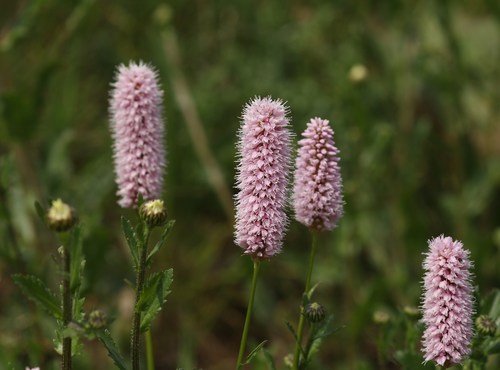
Bistorta officinalis Raf. is an herbaceous perennial that grows 20 to 80 centimetres (8 to 31 in) tall and reaches 90 cm (35 in) wide. It has a thick, twisted rootstock, which is likely the source of its common name snakeroot. Most of its foliage grows from the base of the plant, with only a few smaller leaves growing near the bottom of its flowering stems. Leaves are usually hairless. Basal leaves are longish-oval with long winged stalks and rounded or heart-shaped bases. Upper leaves are few in number, triangular, tapered, and stalkless. Stipules at the base of each leaf fuse into a sheath that surrounds the stem, and petioles are broadly winged. The plant's inflorescence forms a spike. It blooms from late spring into autumn, producing tall, erect, unbranched, hairless stems that end in single terminal club-like spike racemes 5–7 cm (2–3 in) long, filled with rose-pink flowers. Individual pink flowers have five perianth segments, eight stamens, three fused carpels, and three free styles. The fruit is a glossy black nut, and peak flowering occurs in June and July. It grows in moist soil, and goes dormant during dry conditions, losing all foliage until sufficient moisture returns. This species is native to Europe, but it is widely cultivated and has become naturalized in other regions worldwide, including New England in the United States. It typically grows in moist meadows, nutrient-rich wooded swamps, forest edges, wetlands, parks, gardens, and disturbed ground. Bistorta officinalis is grown as an ornamental garden plant; the cultivar 'Superba' has larger, more showy flowers and has earned the Royal Horticultural Society's Award of Garden Merit. It is well suited for use as a marginal plant or in bog gardens. It has also been cultivated as a vegetable, where its roots, leaves, and young shoots are eaten after steaming or boiling. Many wild populations of this plant are escaped garden populations. Bistorta officinalis has a history of traditional medicinal use. Its roots are high in tannic and gallic acids, and both the roots and leaves have been used to treat wounds. The root can be processed to make an astringent for medical use. In Northern England, the plant's leaves were combined with oatmeal, egg, and other herbs to make a bitter Lent pudding; it is the main ingredient in dock pudding, also called Easter-Ledge pudding. Roots of Bistorta officinalis are also eaten in Russia and northern Asia.