About Bistorta bistortoides (Pursh) Small
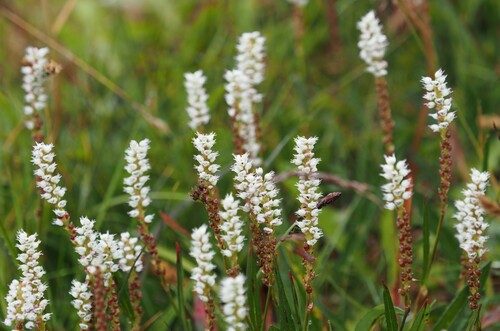
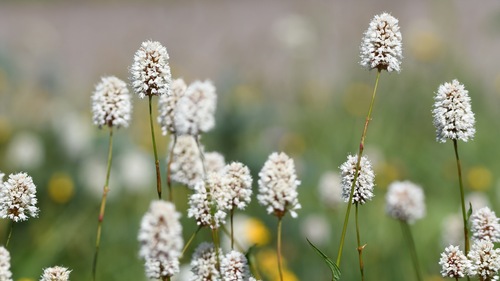
Western bistort, scientifically named Bistorta bistortoides (Pursh) Small, grows from a twisted rhizome that sits shallowly in soil. These rhizomes range in size from that of a pea to that of a thumb. Buds form at the near end of the rhizome up to four years before they sprout. The older far end of the rhizome eventually dies, a process that can take several decades. This is a perennial herbaceous plant that reaches 10 to 75 centimeters (4 to 30 inches) tall when mature. Each plant produces one to three non-woody flowering stems. Ocreae, the sheaths formed from two stipules at the base of each leaf, are round, hairless, brown, smooth, and measure 9–32 millimeters (3⁄8–1+1⁄4 inches) long. Most of the plant's leaves are basal, meaning they attach to the plant at ground level, while smaller leaves also grow on the flowering stems. The leaves are long and narrow, typically 5–22 cm (2–8+1⁄2 in) long (rarely as short as 3.5 cm) and 0.8 to 4.8 cm wide. Their shape is lanceolate, oblanceolate, or elliptic, and they often have asymmetrical bases. Each flowering stem holds two to six leaves; lower leaves attach via short stalks, while upper leaves are stalkless. When young leaves first emerge as snow melts, they are distinctly red. There is usually one inflorescence per stem, and occasionally two. Each inflorescence is dense, shaped from cylindrical to oblong, and measures 1–5 centimeters (3⁄8–2 inches) long and 0.8–2.5 cm (3⁄8–1 in) in diameter. It is densely packed with small white to pinkish flowers, each a few millimeters wide, with eight protruding stamens. Each individual flower has five petal-like sepals called tepals, and has a sharp odor described as similar to dirty socks. Blooming occurs in the spring of the plant's local elevation: it can start as early as May at low elevations, and as late as September at high altitudes. Plant development is rapid for populations in the Rocky Mountains; one studied population in the Medicine Bow Mountains took only one month from first leaf appearance to flowering. The seed-like fruit is a simple, dry achene with a shiny yellow-brown to olive-brown surface and three sides. It measures 3.2–4.2 mm long by 1.3–2 mm wide. Plants growing in Pacific coastal grasslands, coastal mountains, and the Sierra Nevada reproduce via rhizomes and are polyploidal. Plants native to the Rocky Mountains reproduce by seed, are diploid, and do not spread via rhizomes. Western bistort is distributed throughout the mountainous western region of North America, ranging from British Columbia and Alberta south to California, east into the Rocky Mountains, with some populations found in Chihuahua, northern Mexico. It typically grows at high elevations between 1,300 to 3,800 meters (4,300 to 12,500 ft), though the Jepson Herbarium notes it is also uncommonly found in coastal freshwater marshes from sea level to 20 m (66 ft) in northern and central California. Its most common habitat is open meadows in the western mountains, extending into alpine tundra above the timberline. It can be found alongside streams and lakes, in boggy meadows, and in moderately moist clearings. Rocky Mountain populations generally grow in the subalpine zone and alpine tundra, while populations in the Sierra Nevada and coastal mountains tend to occupy lower elevation montane environments. Like other alpine and arctic tundra plants, western bistort maintains high carbohydrate levels to adapt to the challenges of its environment. Around half of the rhizome's carbohydrate reserves are used by the plant in the first week of growth as leaves expand. The lowest carbohydrate levels in its roots and shoots occur immediately before flower buds develop. The type of carbohydrate stored varies by season: the plant contains much more sugar during winter and spring, and much more starch during fall. Rodents and bears eat its roots, while elk and deer browse its foliage. Western bistort is a preferred food source for pikas. In summer, its leaves make up around 9% of the American pika's diet, with its flowers contributing an additional 1%. Leaves are not included in the pika's winter food stores, but flowers account for around 2.5% of a pika's haypile. In addition to their more common feeding on Viola species, caterpillars of the Mormon fritillary (Speyeria mormonia) feed on western bistort in alpine meadows. Western bistort is an important food plant in the traditional hunting and gathering practices of many Indigenous peoples of the Mountain West, including the Blackfoot and Cheyenne. The roots are edible raw, fire-roasted, or boiled; they are starchy and flavorful when raw, but older rootstocks are moderately fibrous. When cooked, their taste is similar to that of water chestnut (Eleocharis dulcis). It has larger rootstalks than the related alpine bistort (Bistorta vivipara). Young leaves are eaten raw or cooked, and have a tart, yet pleasant flavor. The seeds are edible, either boiled as a whole grain or ground into flour for bread. Author Doug Benoliel cautions against eating large amounts of this plant until the digestive system becomes accustomed to it; raw parts of all knotweeds can cause diarrhea if consumed in excess. In traditional Cheyenne cooking, the roots were boiled with meat and were held in high regard. This species is occasionally cultivated in naturalistic meadows. It is hardy in USDA zones 3b to 8b, but requires moist to wet soils.