About Biston betularia (Linnaeus, 1758)
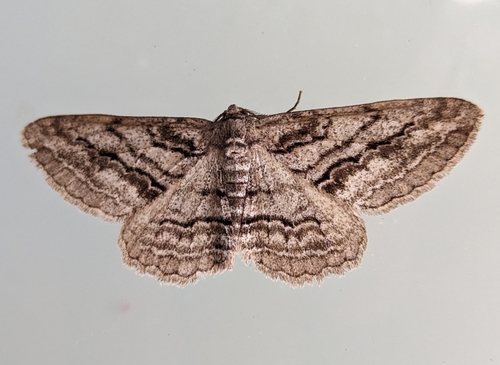
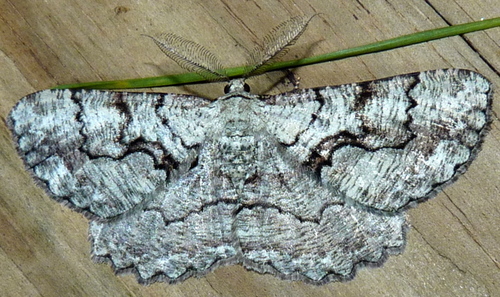
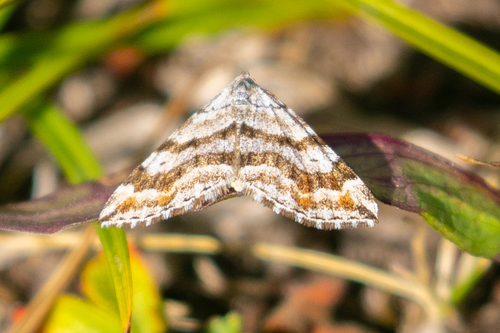
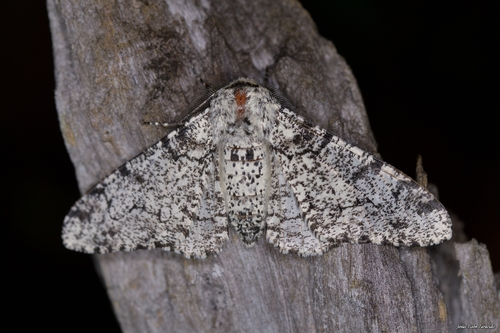
Biston betularia (Linnaeus, 1758), commonly known as the peppered moth, has a wingspan that ranges from 45 to 62 mm (1.8 to 2.4 inches), with a median wingspan of 55 mm (2.2 inches). It has a relatively stout body, with narrow-elongate forewings. Most individuals have white wings peppered with black, and feature more-or-less distinct black cross lines. Rarely, these transverse lines and peppered spotting can be gray or brown; in extremely rare cases, the spotting pattern may combine brown with black or gray. The amount of black speckling varies widely: in some specimens, speckling is almost entirely absent, while in others it is so dense that the wings look black with scattered white sprinkles. Male peppered moths have strongly bipectinate antennae. Prout (1912–16) published an account of this species' forms and its closely related congeners. Biston betularia is distributed across China (Heilongjiang, Jilin, Inner Mongolia, Beijing, Hebei, Shanxi, Shandong, Henan, Shaanxi, Ningxia, Gansu, Qinghai, Xinjiang, Fujian, Sichuan, Yunnan, Tibet), Russia, Mongolia, Japan, North Korea, South Korea, Nepal, Kazakhstan, Kyrgyzstan, Turkmenistan, Georgia, Azerbaijan, Armenia, Europe, and North America. In Great Britain and Ireland, the peppered moth is univoltine, meaning it produces one generation per year, while in south-eastern North America it is bivoltine, producing two generations per year. Like all lepidopterans, it has a four-stage life cycle: eggs, multiple larval instars (caterpillars), soil-overwintering pupae, and adult imagos. During the day, adult moths typically rest on trees, where they are preyed on by birds. Its caterpillars are twig mimics, and vary in body colour between green and brown. Historically, the peppered moth caterpillar was one of the first animals identified as using countershading for camouflage to appear flat, since shading normally acts as a main visual cue to make objects look solid; this identification was published in an 1887 paper by Edward Bagnall Poulton. Research shows that caterpillars can sense the colour of the twigs they rest on through their skin, and match their own body colour to their background to avoid predation. This colour-changing camouflage ability is also seen in cephalopods, chameleons, and some fish, though the colour change is much slower in peppered moth caterpillars. Late in the growing season, caterpillars move into soil to pupate and spend the winter. Adults emerge from pupae between late May and August, with males emerging slightly earlier than females, a pattern common and predicted by sexual selection. Moths emerge late in the day, and dry their wings before taking flight that night. Males fly every night of their adult lives to search for females, while females only fly on their first night as adults. After their first night, females release pheromones to attract males. As pheromones are carried by wind, males travel up the pheromone concentration gradient toward the source. While in flight, adult moths are preyed on by bats. Males guard females from other males until the females finish laying eggs. A female lays roughly 2,000 pale-green, ovoid eggs, each about 1 mm in length, placing them into bark crevices using her ovipositor.