About Bispira volutacornis (Montagu, 1804)
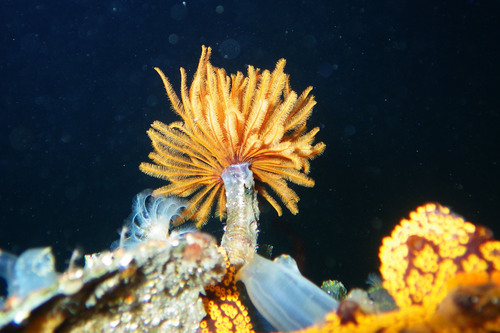
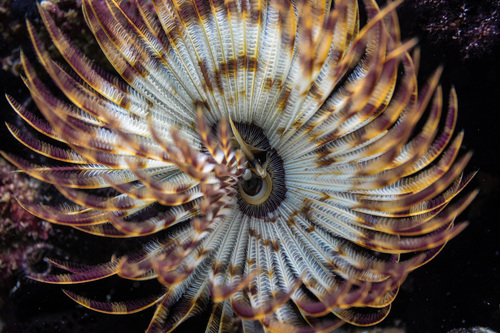
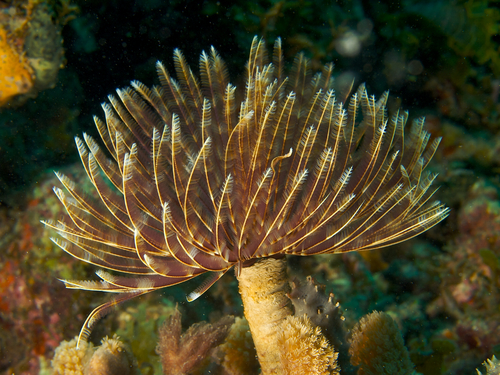
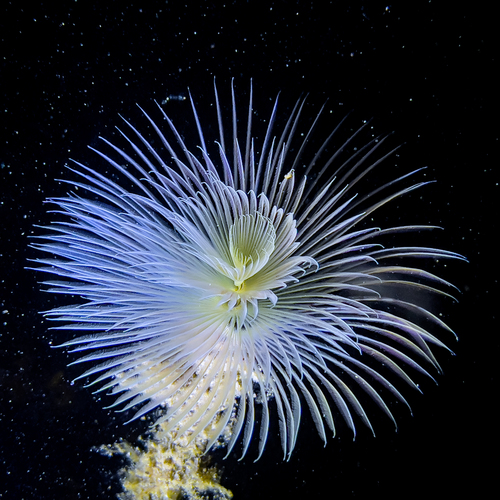
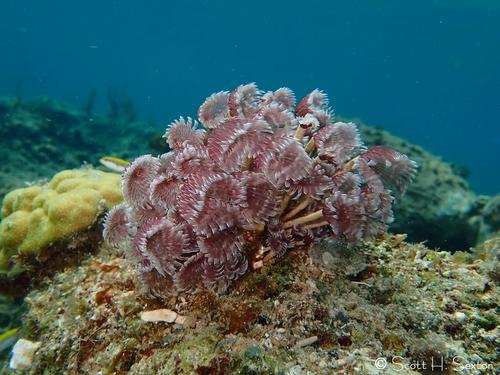
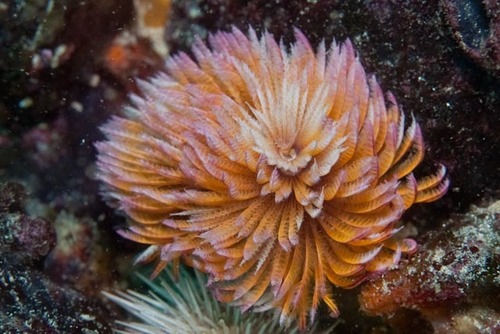
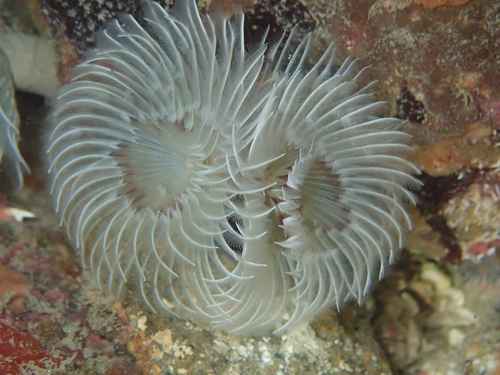
Bispira volutacornis, formally described by Montagu in 1804, is a species of marine worm that typically grows in colonial groups. Each individual worm has a double-headed crown made up of several whorls containing up to 200 feathery plumes. One or more pairs of composite eyes are located on the outer side of this crown. The worm secretes a soft, parchment-like tube around 1 cm (0.4 in) in diameter; the worm protrudes from this tube when active, and can retract fully back into it when disturbed. The outer surface of the tube is often coated with mud or silt. When the crown retracts, the top of the tube pinches closed to form a figure-of-eight shape. The main body of the worm is greenish or brownish, and reaches a maximum length of 10 cm (4 in). The crown's color is variable and often shows distinct banding, ranging from white and tan to reddish-brown. A fully expanded crown measures roughly 4 cm (1.6 in) across. Bispira volutacornis occurs in the Eastern North Atlantic Ocean, the northern North Sea, the English Channel, and the Mediterranean Sea. It inhabits deep tide pools and the shallow sublittoral zone, occurring at depths down to approximately 40 m (130 ft). It grows in crevices and stony areas, and favors locations with high sediment content and low light levels. Bispira volutacornis feeds on plankton, which it captures using its feathery plumes. It also uses these plumes to collect sediment to expand its parchment tube. Each individual worm is either male or female. Gametes are released into the water column, where fertilization takes place. This species is sometimes parasitized by Gastrodelphis clausii, a small copepod. One or more of these copepods move around within the worm's plume crown, and appear to be obligate parasites of Bispira volutacornis.