About Bispira brunnea (Treadwell, 1917)
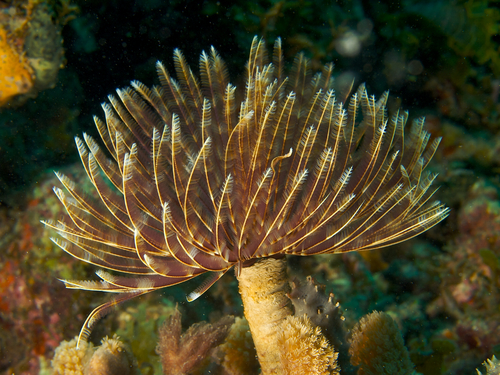
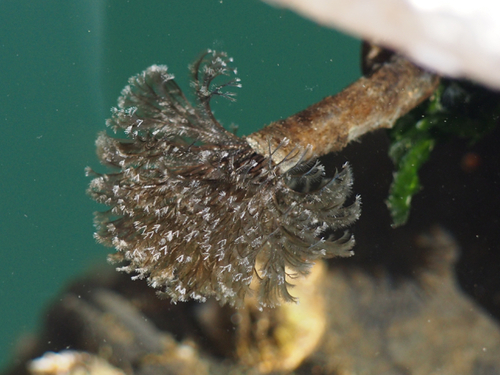
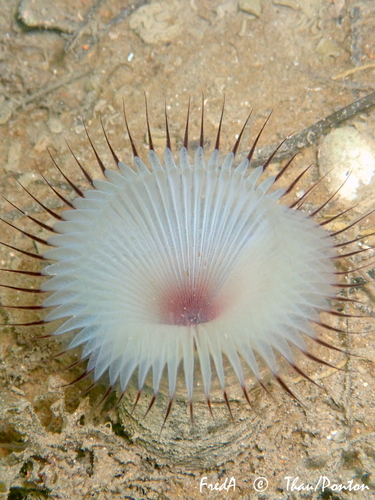
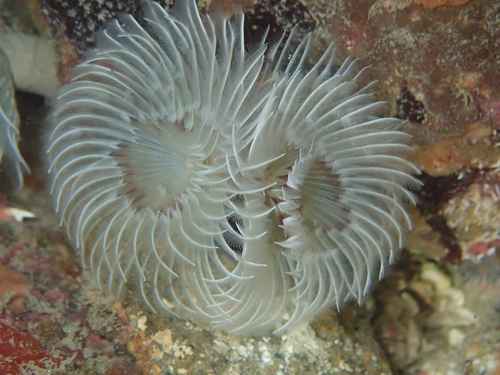
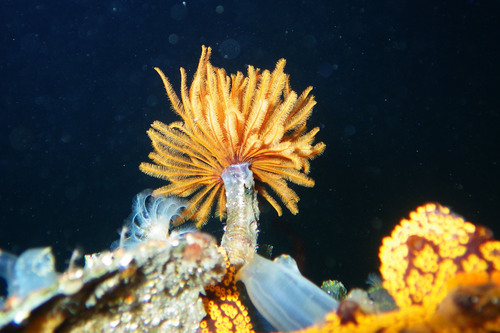
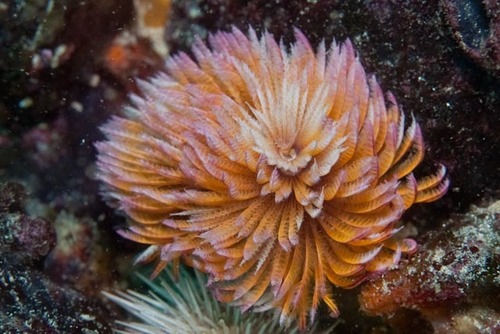
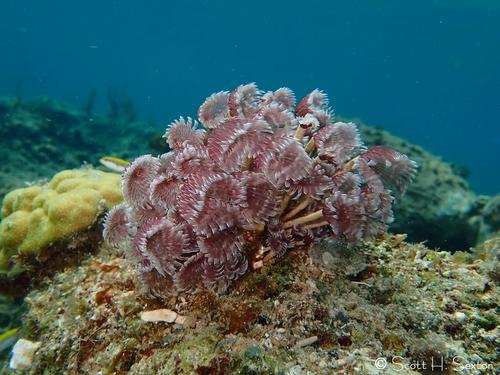
Like other members of the worm family Sabellidae, Bispira brunnea builds itself a soft, non-calcareous tube about 40 mm (1.6 in) long. The worm extends out of this tube to feed, and can retract fully back into it. The tube is cemented to a hard surface such as coral or rock, and white sand grains are bound to its outer surface using secretions from a gland located just behind the worm's head. The worm's trunk is segmented, while its head holds the mouth, sensory organs, and a crown of feather-like tentacles called radioles. It has between 18 and 28 radioles arranged in two semicircular whorls. This species typically grows in colonial groups. The radiole crowns of a colony sway together with water movement, and if one individual retracts in response to stimulation, all other members of the colony do the same. The worms are sensitive to water vibrations, making them difficult to observe in the wild. Their coloration is very variable between groups, but individuals within the same colony usually share similar colouring; possible colourings include brown, orange, purple, or banded patterns, and are often darker toward the centre. Bispira brunnea is found throughout the Caribbean region and around the Bahamas, where it is often common. Its tubes grow on rocks, corals, and sandy sediment, located under overhangs and in crevices, at depths down to approximately 35 m (115 ft). These worms prefer areas with strong water movement, which carry abundant suspended organic material and plankton. Bispira brunnea feeds on plankton filtered from the water by its radioles. Small pinnules lubricated with mucus move trapped food particles down a groove in each radiole to the worm's mouth, which sits at the centre of the radiole crown. Entire colonies of Bispira brunnea are consistently single-sex male, single-sex female, or composed of hermaphroditic individuals. It is thought that these worms are protandrous hermaphrodites, starting their lives as males and transitioning to female as they grow larger. If a predator nips off the worm's radiole crown, the worm can fully regenerate the structure within a few weeks.