About Bison bison (Linnaeus, 1758)
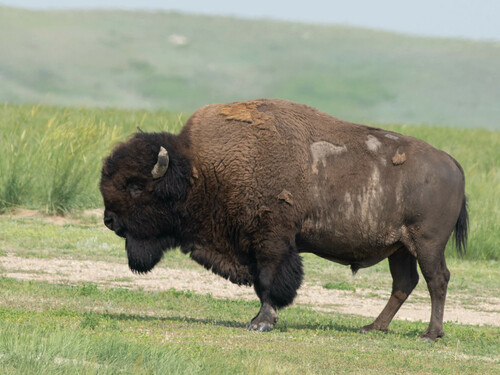
Bison bison (Linnaeus, 1758), commonly called American bison, has a shaggy, long, dark-brown winter coat, and a lighter-weight, lighter-brown summer coat. Males are significantly larger and heavier than females. The two recognized subspecies, plains bison (B. b. bison) and wood bison (B. b. athabascae), generally fall at the smaller and larger end of the species' size range, respectively. Maximum head-rump lengths reach up to 3.5 m (11 ft 6 in) for males and 2.85 m (9 ft 4 in) for females, with tails adding an extra 30 to 95 cm (1 ft 0 in to 3 ft 1 in). Shoulder height at the withers can reach up to 186 cm (6 ft 1 in) for plains bison and 201 cm (6 ft 7 in) for wood bison. Typical body weights across the species range from 318 to 1,179 kg (701 to 2,599 lb). For males, weights range from 460 to 988 kg (1,014 to 2,178 lb), with median weights of 730 to 792.5 kg (1,609 to 1,747 lb) for plains bison and 943.6 kg (2,080 lb) for wood bison. For females, weights range from 360 to 640 kg (790 to 1,410 lb), with median weights of 450 to 497.6 kg (992 to 1,097 lb). The lowest recorded weights typically correspond to bison around 2 to 3 years of age, when they reach sexual maturity. The heaviest wild male plains bison ever recorded weighed 1,270 kg (2,800 lb), while some males have been estimated to reach 1,400 kg (3,000 lb). On average, wood bison are significantly larger and heavier than plains bison, though limited recorded samples exist for wood bison following the rediscovery of a relatively pure herd. At Elk Island National Park, which hosts wild populations of both subspecies, recorded maximum weights for mature males are 1,186 kg (2,615 lb) for plains bison and 1,099 kg (2,423 lb) for wood bison; the park also notes that three-quarters of all bison weighing over 1,000 kg (2,200 lb) are wood bison. When raised in captivity and farmed for meat, bison can grow unnaturally heavy; the largest semidomestic bison recorded weighed 1,724 kg (3,801 lb). Bison have massive heads and forequarters, and both sexes have short, curved horns that can grow up to 60 cm (2 ft) long with a tip-to-tip width of 90 cm (3 ft) to 124 cm (4 ft). Bison use these horns to fight for status within the herd and for defense. Bison are herbivores that graze on the grasses and sedges of North American prairies. Their daily routine consists of alternating two-hour periods of grazing, resting, and cud chewing, before moving to a new location to graze again. Sexually mature young bulls may attempt to mate with cows starting at two to three years of age, but if more mature bulls are present, they usually cannot compete successfully until they reach five years of age. For the first two months of life, calves are lighter in color than mature bison. Very rarely, white bison (also called white buffalos) are born. As of 2010, total population estimates for American bison ranged from 400,000 to 500,000. Approximately 20,500 bison live in 62 conservation herds, with the remainder living in around 6,400 commercial herds. According to the IUCN, roughly 15,000 bison are considered wild, free-range animals not primarily confined by fencing. The Nature Conservancy (TNC) has reintroduced bison to over a dozen nature preserves across the United States. In October 2016, TNC established the country's easternmost bison herd at Kankakee Sands nature preserve in Morocco, Newton County, Indiana. In 2014, U.S. Tribes and Canadian First Nations signed a treaty to support bison restoration, the first such treaty signed in nearly 150 years. American bison inhabit river valleys, prairies, and plains. Their typical habitat is open or semiopen grasslands, as well as sagebrush, semiarid lands, and scrublands. Historically, some lightly wooded areas also supported bison populations. Bison also graze in hilly or mountainous areas with non-steep slopes. While bison are not particularly known as high-altitude animals, the Yellowstone Park bison herd is frequently found at elevations above 2,400 m (8,000 ft), and the Henry Mountains bison herd in Utah occurs on plains around the Henry Mountains and in the range's mountain valleys up to an altitude of 3,000 m (10,000 ft). Reintroduced plains bison in Banff National Park have been observed roaming mountainous areas, including high ridges and steep drainages. Archaeological finds show some bison lived their entire lives within mountain ranges, while others migrated in and out. Bison in Yukon, Canada, typically spend summers on alpine plateaus above treeline. Aside from the long-erased paths of mastodons or muskoxen and the travel routes of mound builders, the earliest established North American travel routes were traces created by bison and deer during seasonal migration, and between feeding grounds and salt licks. Countless bison hooves instinctively followed routes along watersheds and ridge crests to avoid summer muck and winter snowdrifts in lower areas, and these naturally followed paths of least resistance across rolling terrain. Aboriginal North Americans used these routes to reach hunting grounds and as warrior paths. The routes were invaluable to explorers and later adopted by pioneers. Bison migration traces were characteristically north-south, but several key east-west bison trails were later used as routes for railways, including the route through the Cumberland Gap across the Blue Ridge Mountains into upper Kentucky. Another heavily used trace crossed the Ohio River at the Falls of the Ohio and ran west, crossing the Wabash River near Vincennes, Indiana. As Senator Thomas Hart Benton phrased it in saluting these instinctive path-makers, the bison paved the way for the railroads to the Pacific. Bison are migratory, and their herd migrations can be directional as well as altitudinal in some regions. During summer, bison make regular daily movements between foraging sites. In Hayden Valley, Wyoming, bison have been recorded traveling an average of 3 km (2 mi) per day. Summer range for bison appears to be shaped by seasonal vegetation changes, the spacing and size of foraging sites, the breeding rut, and the number of biting insects. Preserve size and water availability may also influence range selection. Bison are largely grazers that eat primarily grasses and sedges, and will switch to sagebrush and other non-graminoid plants during periods of limited resources. On shortgrass pastures, bison mostly eat warm-season grasses. On mixed prairie, cool-season grasses and some sedges make up 79–96% of their diet. In montane and northern areas, bison select sedges year-round. Bison consume water or snow on a daily basis. Female bison live in maternal herds that include other females and their offspring. Male offspring leave their maternal herd when around three years old, and either live alone or join bachelor herds made up of other males. Male and female herds usually do not mix until the breeding season, which runs from July through September, though female herds may occasionally include a small number of older males. During the breeding season, dominant bulls maintain small harems of females to mate with. Individual bulls "tend" cows by following them around and chasing away rival males, until the cow allows mating. The tending bull will position his body to block the female's view, so she cannot see other challenging bulls. Challenging bulls may bellow or roar to get the female's attention, and the tending bull will bellow or roar in response. The most dominant bulls mate during the first 2–3 weeks of the breeding season, while more subordinate bulls mate with any remaining unmated cows that are still in estrus. Male bison do not participate in raising young. Bison herds have dominance hierarchies for both males and females. A bison's dominance is linked to its birth date: bison born earlier in the breeding season are more likely to be larger and more dominant as adults. Because dominant bison breed earlier in the season, they pass this dominance on to their offspring. In addition to higher dominance, older bison of a generation also have a higher fertility rate than younger bison. Bison mate in August and September, with a gestation period of 285 days. A single reddish-brown calf nurses until the cow gives birth to the next calf; if the cow is not pregnant, a calf will nurse for 18 months. Cows nurse their calves for at least 7 or 8 months, though most calves are weaned before the end of their first year. Female bison reach sexual maturity and are able to produce a calf by three years of age. In boreal biomes, the bison birthing period is longer than that of other northern ungulates such as moose and caribou. Bison have a typical life expectancy of around 15 years in the wild and up to 25 years in captivity. However, in a hunted population in northern Canada that is also subject to wolf predation, males have been reported to live to 22 years of age and females to 25 years of age. Bison have been observed displaying homosexual behaviors, with males showing this behavior much more often than females. For male bison, this behavior is unlikely related to dominance, and is instead thought to support social bonding or help individuals gain sexual experience.