About Birgus latro (Linnaeus, 1767)
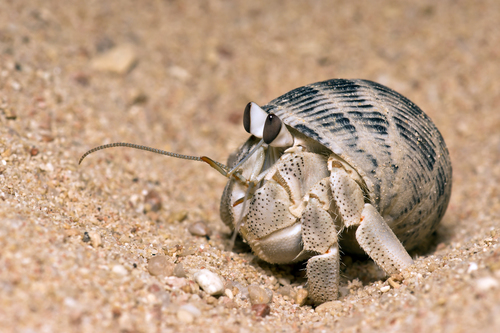
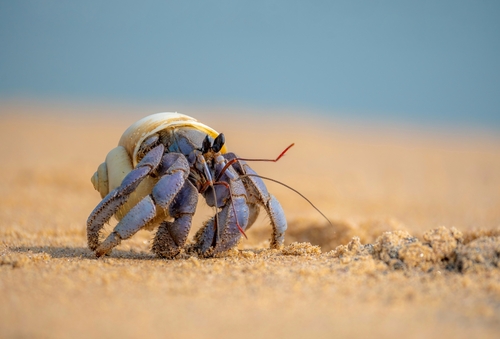
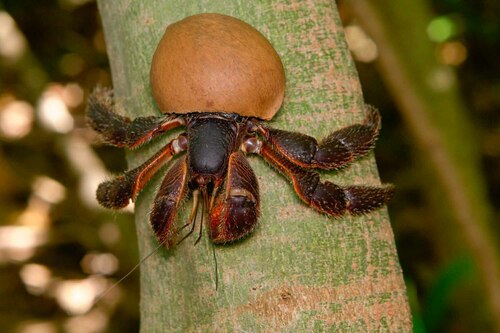
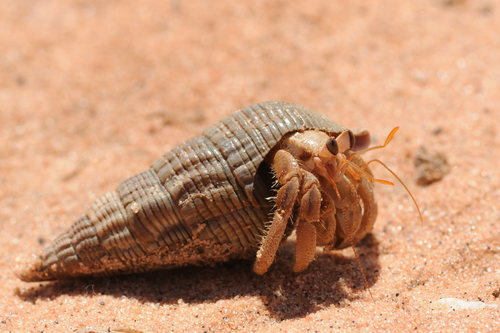
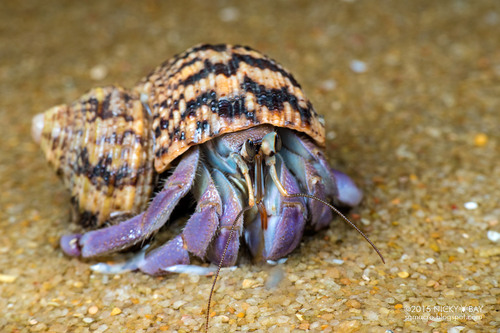
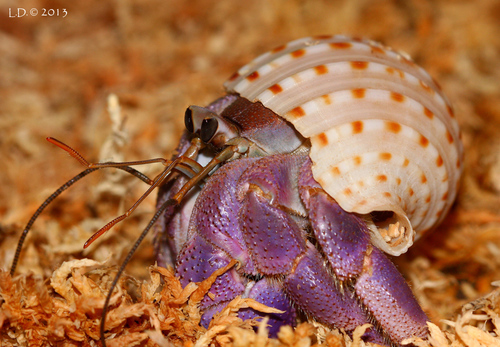
Birgus latro (Linnaeus, 1767), commonly called the coconut crab, is both the largest living terrestrial arthropod and the largest living terrestrial invertebrate. Reported body measurements vary, but most sources state maximum body length of up to 40 cm (16 in), maximum weight of up to 4.1 kg (9 lb), a leg span exceeding 0.91 m (3 ft), and males are generally larger than females. Its carapace can reach 78 mm (3+1⁄16 in) in length and up to 200 mm (8 in) in width. Like all decapods, the coconut crab’s body is split into an anterior cephalothorax, which bears 10 legs, and an abdomen. The foremost pair of legs holds large chelae (claws), with the left claw larger than the right. The next two pairs are large, powerful walking legs with pointed tips, which let coconut crabs climb vertical and even overhanging surfaces, matching the structure seen in other hermit crabs. The fourth pair of legs is smaller, ending in tweezer-like chelae: young coconut crabs use this pair to grip the inside of shells or coconut husks that juveniles carry for protection, while adults use this pair for walking and climbing. The final, last pair of legs is very small: females use it to tend their eggs, and males use it during mating. This last pair is usually held inside the carapace, in the cavity that contains the animal’s breathing organs. Individual coconut crabs from different islands vary in color, ranging from orange-red to purplish blue. Blue is the predominant color in most regions, but in some locations such as the Seychelles, most individuals are red. Although B. latro is a derived type of hermit crab, only juveniles use recovered snail shells to protect their soft abdomens, and adolescents sometimes use broken coconut shells for this same purpose. Unlike other hermit crabs, adult coconut crabs do not carry shells. Instead, they harden their abdominal terga by depositing chitin and calcium carbonate. Without the physical size constraint of living inside another creature’s shell, B. latro grows much larger than its relatives in the family Coenobitidae. Despite being a product of carcinization, B. latro bends its tail beneath its body for protection like most true crabs. The hardened abdomen protects the coconut crab and reduces water loss on land, but it must be molted periodically. Adult coconut crabs molt annually, digging a burrow up to 1 m (3 ft 3 in) long to hide in while their new soft shell hardens. It takes 1 to 3 weeks for the exoskeleton to harden, depending on the individual’s size, and the animals remain in the burrow for 3 to 16 weeks, again varying by individual size. Coconut crabs inhabit the Indian Ocean and central Pacific Ocean, and their distribution closely matches that of the coconut palm. The western edge of B. latro’s range is Zanzibar, off the coast of Tanzania, while the northern and southern range limits are marked by the tropics of Cancer and Capricorn respectively. Very few populations occur in subtropical areas, such as the Ryukyu Islands. Some evidence shows coconut crabs once lived on mainland Australia, Madagascar, Rodrigues, Easter Island, Tokelau, the Marquesas Islands, and possibly India, but the species is now extirpated from these areas. Because adult coconut crabs cannot swim, they must have colonized islands as planktonic larvae. Christmas Island in the Indian Ocean hosts the world’s largest and densest coconut crab population, though Christmas Island red crabs (Gecarcoidea natalis) outnumber coconut crabs there by more than 50 times. Other Indian Ocean populations are found in the Seychelles, including Aldabra and Cosmoledo, but coconut crabs are extinct on the Seychelles’ central islands. They also occur on several of the Andaman and Nicobar Islands in the Bay of Bengal, and on most islands and northern atolls of the Chagos Archipelago. In the Pacific, the full extent of the coconut crab’s range was discovered gradually. Charles Darwin originally believed the species was only found on “a single coral island north of the Society group”. The coconut crab is actually far more widespread, though it is not abundant on every Pacific island it inhabits. Large populations live on the Cook Islands, especially Pukapuka, Suwarrow, Mangaia, Takutea, Mauke, Atiu, and Palmerston Island. These islands lie close to the eastern limit of the species’ range, along with the Line Islands of Kiribati, where coconut crabs are especially common on Teraina (Washington Island), which has abundant coconut palm forest. The Gambier Islands mark the species’ eastern range limit. Coconut crabs are among the most terrestrial-adapted decapods, with most of their life history centered around a land-based existence; they will actually drown in seawater in less than a day. Coconut crabs live alone in burrows or rock crevices, depending on local terrain. They dig their own burrows in sand or loose soil. They stay hidden during the day to reduce water loss caused by heat. Coconut crab burrows contain very fine but strong coconut husk fibers, which the animal uses as bedding. While resting in its burrow, the coconut crab closes the entrance with one of its claws to create a moist microclimate inside the burrow, which is required for its breathing organs to function. In areas with large coconut crab populations, some individuals may come out during the day, likely to gain an advantage when searching for food. They also emerge when the weather is humid or raining, as these conditions let them breathe more easily. They live almost entirely on land, and only return to the sea to release their eggs; for example, on Christmas Island, B. latro is abundant 6 km (3+1⁄2 mi) from the sea. Coconut crabs mate frequently and quickly on dry land between May and September, with most mating occurring between early June and late August. Males produce spermatophores and deposit a mass of spermatophores on the female’s abdomen; the oviducts open at the base of the third pereiopods, and fertilization is thought to occur on the external surface of the abdomen as eggs pass through the spermatophore mass. Egg extrusion happens on land in crevices or burrows near the shore. Females lay eggs shortly after mating, glue them to the underside of their abdomen, and carry the fertilized eggs under their body for a few months. When the eggs are ready to hatch, the female migrates to the seashore and releases the larvae into the ocean. Laying eggs carries significant risk for the coconut crab, as it cannot swim; if a coconut crab falls into the water or is swept away, its weight makes swimming back to dry land difficult or impossible. Egg-laying usually occurs on rocky shores at dusk, particularly when this coincides with high tide. Empty egg cases remain on the female’s body after larvae are released, and the female eats them within a few days. Larvae float in the ocean’s pelagic zone with other plankton for 3 to 4 weeks, and a large number are eaten by predators during this time. Larvae pass through three to five zoea stages before molting into the postlarval glaucothoe stage, a process that takes 25 to 33 days. Once they reach the glaucothoe developmental stage, they settle to the ocean bottom, find and wear a suitably sized gastropod shell, and migrate to the shoreline with other terrestrial hermit crabs. At this stage, they sometimes visit dry land. After this, they leave the ocean permanently and lose the ability to breathe in water. Like all hermit crabs, they change shells as they grow. Young coconut crabs that cannot find a correctly sized seashell often use broken coconut pieces instead. Once they outgrow their carried shells, they develop a hardened abdomen. Coconut crabs reach sexual maturity around 5 years after hatching. They reach their maximum size only after 40 to 60 years. They grow remarkably slowly, and Michelle Drew of the Max Planck Institute has proposed they may take up to 120 years to reach full size.