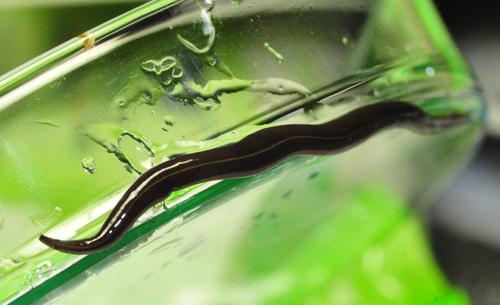
About Bipalium kewense Moseley, 1878
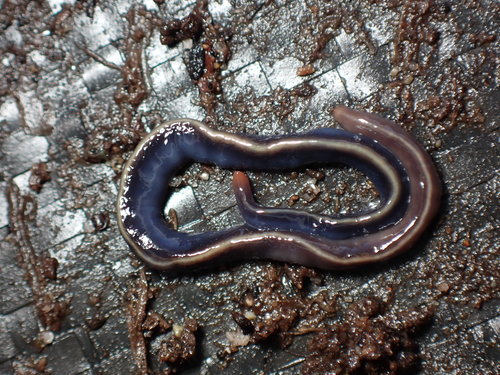
Bipalium kewense Moseley, 1878 is a very long land planarian. Preserved specimens grow up to 20 centimeters in length, and living specimens can reach even longer sizes. The anterior end, or "head," is expanded into a transverse semilunar shape, and the narrowest point of the body is located just behind the head, in a region called the "neck." Its dorsal surface is light brown, with five black to grey longitudinal stripes that start at the neck. The median and marginal stripes are narrow, black, and very distinctly marked. The lateral stripes, which sit between the median and marginal stripes, are usually grey, broad, and have diffuse margins. The neck is typically marked by an incomplete black collar formed when the marginal and lateral stripes join together; this is a key feature that distinguishes Bipalium kewense from similar species. The head is usually darker than the background color of the dorsum and has no stripes. The ventral surface is light ochre externally, and whitish over the creeping sole, which is lined on the outside by two diffuse grey-violet longitudinal lines. Bipalium kewense is thought to be native to Southeast Asia, but it can now be found worldwide, and has been reported on every continent except Antarctica. It was most likely introduced to new regions through international plant trade, as it is very commonly found associated with plant pots. The species was first discovered in 1878 in the Kew Park area, located in the London Borough of Richmond upon Thames, United Kingdom, which gives the species its specific epithet kewense. All species in the genus Bipalium are hermaphroditic, but Bipalium kewense has rarely been observed using sexual reproduction as its primary reproductive method. Asexual fragmentation is the main way B. kewense reproduces in temperate regions. Longer individuals usually release posterior body fragments through transverse fission. These fragments are motile, and regenerate a new head plate and pharynx within a few weeks. This reproductive strategy is considered one of the reasons that B. kewense and other Bipalium species have been able to successfully colonize new areas. While there is little evidence of sexual reproduction in these planarians, there have been multiple reported discoveries of egg capsules. These egg capsules shared several traits with those of Bipalium adventitium, including coloration and incubation period. The most recently discovered egg capsule hatched offspring that did not fully resemble adult B. kewense, and were considerably larger than B. adventitium offspring. Bipalium kewense is one of the few known terrestrial invertebrates that produce tetrodotoxin, a neurotoxin that causes paralysis. It is hypothesized that this toxin helps the planarian subdue its prey, and also protects it from predators.