About Billardiera heterophylla (Lindl.) L.W.Cayzer & Crisp
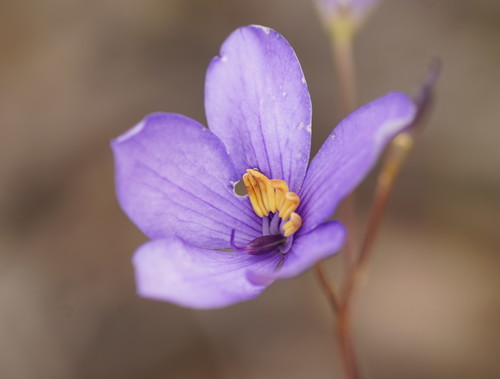
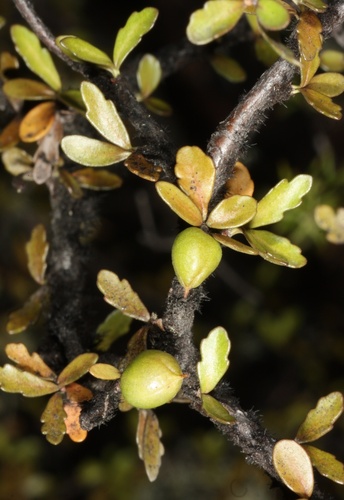
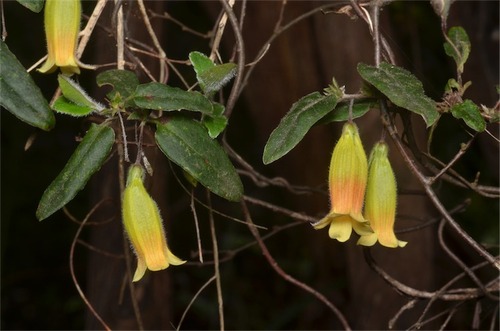
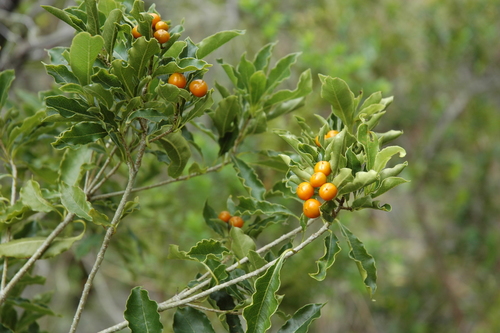
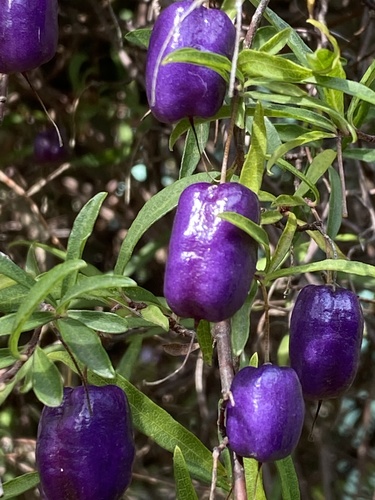
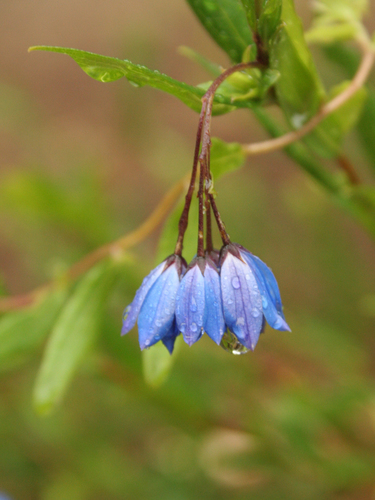
Billardiera heterophylla is a climbing shrub with vine-like branches that twine around other plants for support. Its upper leaf surface is glossy green; individual leaves measure 10–60 millimetres (0.4–2.4 in) long and 2–22 millimetres (0.1–0.9 in) wide. The inflorescence is either a single hanging flower, or a hanging cluster of up to five flowers. Each flower has five petals up to 1 cm long, and petals may range in color from white to deep blue or pinkish. The fruit is a berry with pulpy flesh and many seeds. These fruits are purplish-green, cylindrical, and sausage-shaped, initially densely hairy when young, becoming smooth as they ripen, and reach up to 20 millimetres (0.8 in) in length, while the berry as a whole can grow up to 3 cm (1 in) long. This species is native to the Avon and Eyre districts of southwest Western Australia, where it grows in open eucalypt forest and woodland, coastal heathland, and near inland salt lakes. It is very good at colonising disturbed sites. Due to its cultivation and natural tendency to spread, its range has expanded over time, making it difficult to determine its exact original distribution. Billardiera heterophylla is a popular, widely cultivated garden plant. It has been sold within Australia and internationally for at least 100 years, with seeds available in Jamaica as early as 1887. It has become a serious environmental weed in the temperate regions of Victoria, South Australia and Tasmania. It produces large amounts of seed that germinates easily after fire or disturbance. It is also thought that native animals spread the seeds by eating them; this movement carries the plant to new sites, and ingestion also makes the seeds more likely to germinate successfully. In 2013, the plant was awarded the Royal Horticultural Society's Award of Garden Merit.