About Bidens pilosa L.
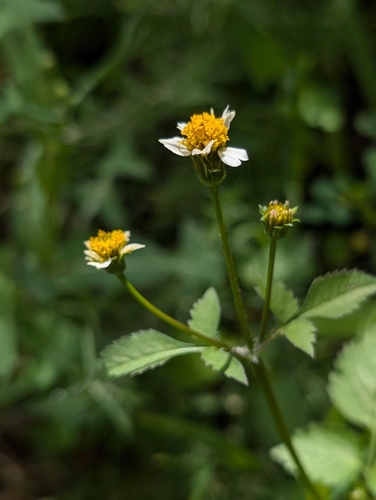
Bidens pilosa L. is a branched annual forb with a slender, gracile growth habit, reaching up to 1.8 meters tall. It grows aggressively on disturbed land and often becomes weedy. All of its leaves are arranged oppositely, and range from simple to pinnate in form; upper leaves have three to five toothed, ovate-to-lanceolate leaflets. Its leaf petioles are slightly winged. This plant can flower at any time of year, but flowers mainly in summer and autumn in temperate regions. Its flowers are small heads carried on relatively long stalks called peduncles. Each head holds around four or five broad white ray florets (also known as ligules), which surround many tubular yellow disc florets that lack ligules and later develop into barbed fruits. The fruits are slightly curved, stiff, rough black rods that are tetragonal in cross-section, measure about 1 cm long, and typically have two to three stiff, heavily barbed awns at their far end. The mature fruit clusters (infructescences) form star-shaped spherical burrs between one and two centimeters in diameter. The barbed spines on the achenes stick to feathers, fur, wool, clothing, or any other part of people or animals that brush against the plant. This is an effective method of zoochorous seed dispersal, as animals carry the fruits to new locations. This dispersal mechanism has allowed Bidens pilosa to become a noxious weed in both temperate and tropical regions. Small Bidens pilosa plants can be successfully removed by hand weeding, but removed plants must be bagged after pulling, and thick mulches can prevent the species from growing entirely. The species is native to tropical America, and is widely naturalized across all warm temperate and tropical regions of the world. It grows as a weed in gardens, woodlands, and waste areas. Although Bidens pilosa is primarily considered a weed, it is also used as a source of food and alternative medicine in many parts of the world. Its leaves have a resinous flavor, and are eaten raw, added to stews, or dried for storage. In eastern Africa, it is used medicinally to treat wounds. Extracts of Bidens pilosa are used to treat malaria in southern Africa. During the Vietnam War, soldiers used this herb as a vegetable, which gave it the common nickname "soldier vegetable".