About Betula utilis D.Don
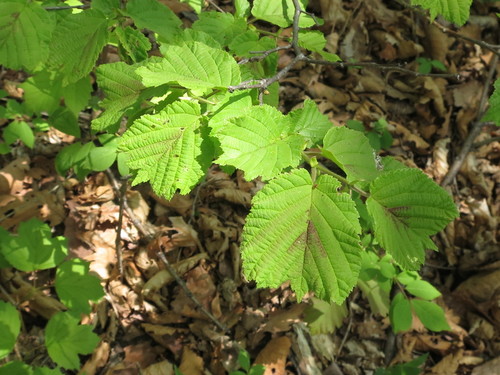
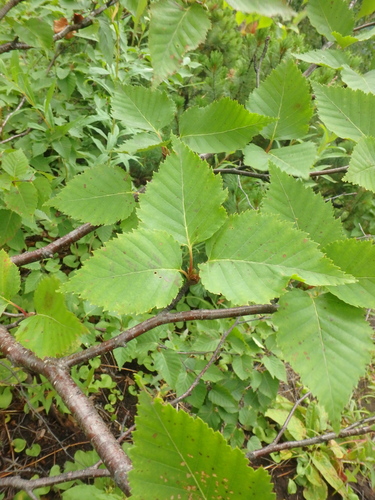
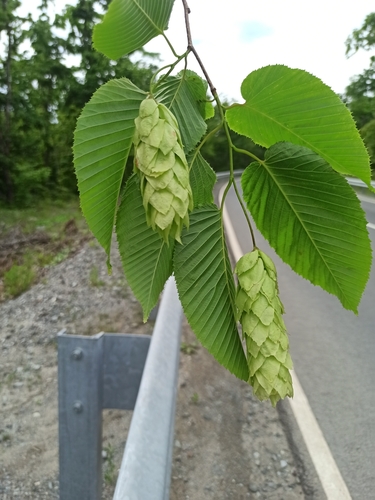
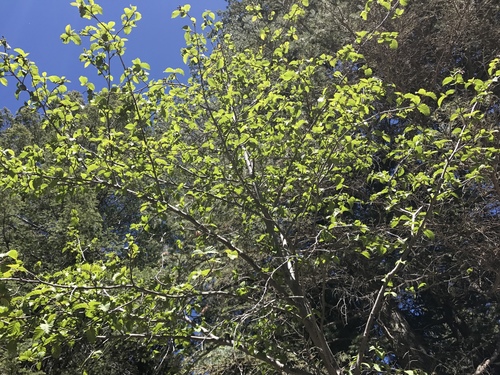
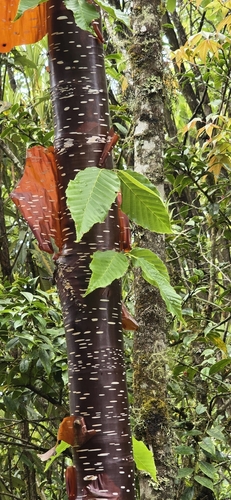
In its native habitat, Betula utilis D.Don usually forms forests, growing as a shrub or tree that can reach up to 20 m (66 ft) tall. It frequently grows among scattered conifers, with a shrub undergrowth that typically includes evergreen Rhododendron. This tree depends on snowmelt moisture rather than monsoon rains. Deep winter snow in the Himalaya often creates pressure that leaves the tree with very bent growth. Its leaves are ovate, 5 to 10 cm (2.0 to 3.9 in) long, with serrated margins and slight hairiness. Flowering occurs from May to July, with only a few male catkins, and short, single (sometimes paired) female catkins. Male flowers have a four-part perianth, while the perianth is absent in female flowers. Fruits ripen between September and October. The bark is thin, papery, very shiny, and ranges in color from reddish brown and reddish white to white, with horizontal lenticels. It peels off in broad, horizontal belts, which makes it very usable for creating even large pages for texts. A local fungal growth called bhurja-granthi forms black lumps on the tree that weigh up to 1 kg. The wood is very hard, heavy, and quite brittle, with pink or light reddish brown heartwood. Centuries ago in India, the bark of this Himalayan birch was used as a writing surface for Sanskrit literature manuscripts, especially in Kashmir. Its use as book paper is mentioned by early Sanskrit writers Kalidasa (c. 4th century CE), Sushruta (c. 3rd century CE), and Varahamihira (6th century CE). In the late 19th century, Kashmiri Pandits reported that all their books were written on Himalayan birch bark until Akbar introduced paper in the 16th century. The Sanskrit word for the tree is bhûrja, which shares similarity with other Indo-European words that are the origin of the common name "birch". The bark is still used today to write sacred mantras, which are placed in amulets and worn around the neck for protection or blessing. This practice was mentioned as early as the 8th or 9th century CE in the Lakshmi Tantra, a Pancaratra text. Legend also says the bark was used as clothing by attendants of Shiva. The bark is widely used as packaging material, particularly for butter, plus for roof construction, umbrella covers, bandages, and other purposes. The wood is used for bridge construction, and the foliage is used as fodder. The most widespread use is as firewood, which has caused large areas of the tree's native habitat to be eliminated or reduced. Parts of the plant, including the bhurja-granthi fungal growth, have also long been used in local traditional medicine.