About Betula glandulosa Michx.
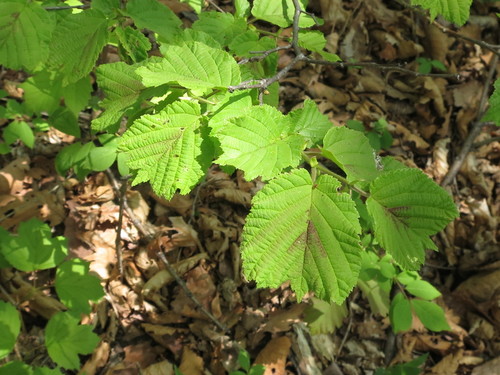
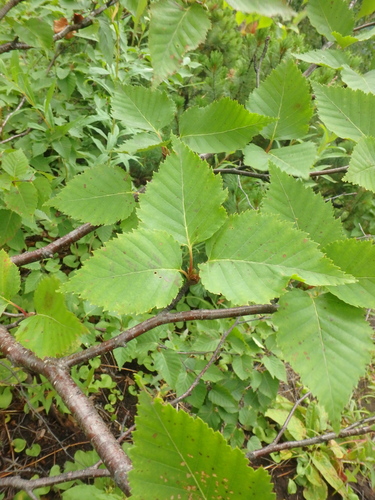
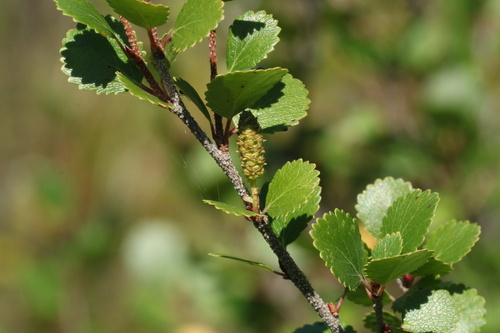
Betula glandulosa Michx., commonly called American dwarf birch, is a multi-stemmed shrub that usually reaches 1–3 m (3.3–9.8 ft) in height and often forms dense thickets. Its trunks are slender, rarely more than 5–10 cm (2–4 in) in diameter, and covered in smooth, dark brown bark. Its leaves are nearly circular to oval, 0.5–3 cm (1⁄4–1+1⁄8 in) long and 1–2.5 cm (3⁄8–1 in) broad, with toothed margins. The species produces erect fruiting catkins that measure 1–2.5 cm (3⁄8–1 in) long and 5–12 mm (3⁄16–15⁄32 in) broad. American dwarf birch is closely related to Betula nana (dwarf birch), and is sometimes classified as a subspecies of it, under the name B. nana subsp. glandulosa. It differs from typical B. nana by having glandular warts on its shoots and longer leaf petioles. Hybrids between American dwarf birch and several other birch species have been recorded.
American dwarf birch grows in arctic and cool temperate regions, ranging from Alaska east to Newfoundland and southern Greenland. In the western part of its range, it extends south at high elevations to northern California, Colorado, and the Black Hills of South Dakota; in the eastern part, it occurs locally as far south as northern New York. In the Arctic, it can be found growing from sea level, while in the southern end of its range it grows at elevations up to 3,400 metres (11,200 ft). It is most often a wetland species that grows in bogs, muskegs, and other moist, nutrient-poor soils, but it can be found across a wide variety of site types, from rocky subarctic areas to boreal forests with deep, organic-rich soils. It is the most common shrub at treeline in interior Alaska, where it forms a nearly continuous zone between the treeline and alpine tundra.
Many wildlife species depend on American dwarf birch as a food source, especially ungulates including moose, deer, caribou, and elk. How preferred this shrub is as food varies between different populations; for example, moose in Alberta are known to graze on it heavily, while moose in Alaska have been observed eating it only in low amounts. Bears, small mammals, birds, and insects also use the shrub as food. American dwarf birch provides cover for ptarmigans, and grizzly bears regularly use it to build their dens. This species is valued for its ability to control erosion, and has been used to help stabilize stream banks.