About Betta splendens Regan, 1910
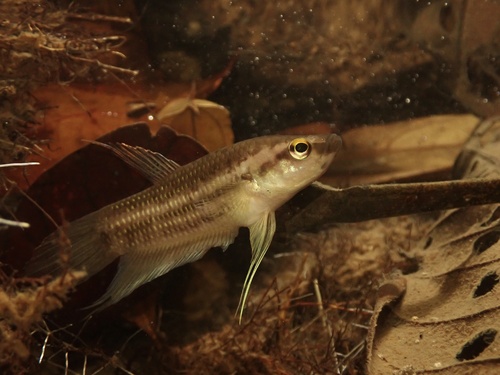
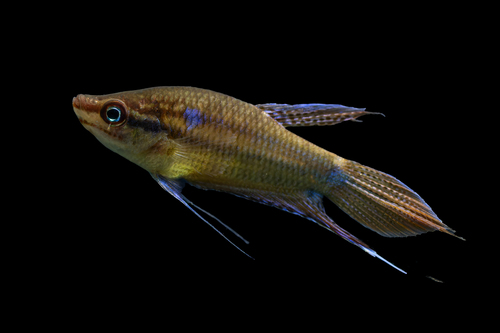
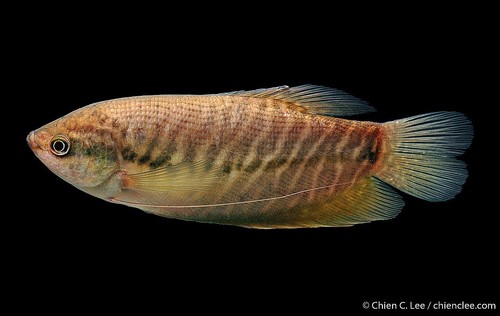
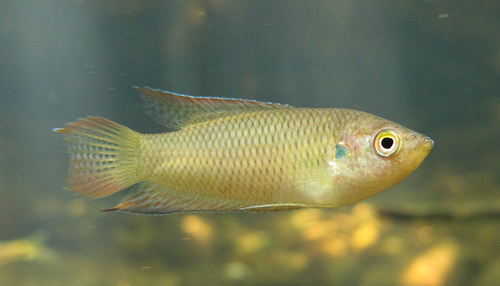
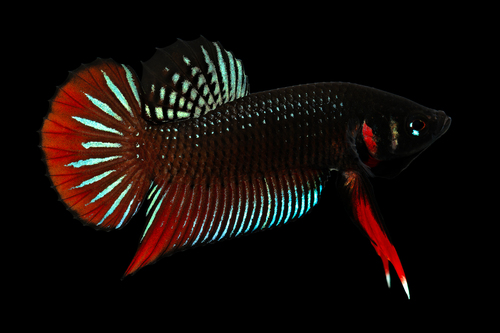
Betta splendens Regan, 1910 (commonly called Siamese fighting fish) usually reaches a length of 6–8 cm (2.4–3.1 in). While aquarium-bred individuals are widely known for their bright colors and large, flowing fins, wild B. splendens are generally colored green, brown, and grey, with shorter fins; wild fish only show strong bright colors when agitated. In captivity, Siamese fighting fish have been selectively bred to produce a wide range of vibrant colors and different tail types. The wide variety of colors seen today in pet stores comes from the domestication of B. splendens. Because pet markets have higher demand for visually striking bettas, breeders continue to prioritize these varieties. Naturally colored green, brown, and grey bettas are now rarely seen in pet stores, overshadowed by more visually appealing colored varieties. Male and female B. splendens can look similar, but one reliable way to tell them apart is the ovipositor tube, a structure females use to deliver eggs.
Multiple sources have recorded the native distribution and habitat of B. splendens. Witte and Schmidt (1992) state the species is native to Southeast Asia, including the northern Malay Peninsula, central and eastern Thailand, Kampuchea (Cambodia), and southern Vietnam. Vidthayanon (2013), a Thai ichthyologist and senior biodiversity researcher at WWF Thailand, notes the species is endemic to Thailand, ranging from the Mae Khlong to Chao Phraya basins, along the eastern slope of the Cardamom Mountains in Cambodia, and on the Isthmus of Kra. A 2019 report from Froese and Pauly identifies B. splendens as native to Cambodia, Laos, Thailand, and Vietnam. The species is also found across the neighboring Malay Peninsula and in adjacent parts of Sumatra, most likely as a result of human introduction.
Wherever they occur, B. splendens typically inhabits shallow water bodies with abundant vegetation, including marshes, floodplains, and paddy fields. Historically, the widespread practice of rice farming across Southeast Asia created ideal habitat for bettas, which led to their discovery and eventual domestication by humans. The combination of shallow water and high air temperature causes rapid gas evaporation, leading to significant oxygen deficits in the species' natural habitat. This environment likely drove the evolution of the lung-like labyrinth organ, which, like all members of the suborder Anabantoidei, allows Siamese fighting fish to breathe directly from air. As a result, bettas can survive and even thrive in harsher environments than most other freshwater fish, which leaves them with fewer natural predators and competitors. In the wild, bettas have a fairly low population density of 1.7 individuals per square meter.
The tropical climate of the betta's natural habitat is marked by sudden, extreme fluctuations in water availability, chemistry, and temperature. Water pH can range from slightly acidic (pH 6.9) to highly alkaline (pH 8.2), while air temperatures can drop as low as 15 °C (59 °F) and rise as high as 40 °C (100 °F). As a result, Siamese fighting fish are highly adaptable and hardy, able to tolerate a wide range of harsh or toxic environments. This adaptability explains both their popularity as pets and their ability to successfully colonize water bodies around the world. Wild bettas prefer water bodies with abundant aquatic vegetation and surface foliage, such as fallen leaves and water lilies. Dense vegetation provides protection from predators and acts as a buffer between aggressive males, who coexist by claiming dense plant patches as territory. Vegetation also protects females during spawning and fry during their earliest, most vulnerable life stages.
When a male betta is interested in mating with a female, he will flare his gills, spread his fins, and twist his body in a dance-like display. Receptive females respond by darkening their color and developing vertical markings called "breeding bars". Males build bubble nests of varying sizes and thicknesses at the water surface, which potential mates may examine. Most males build these nests regularly even when no female is present. Plants or rocks that reach the water surface often form a base for these bubble nests. During courtship, the male may act aggressively toward the female, chasing or nipping her fins. The spawning act itself is called a "nuptial embrace", as the male wraps his body around the female. Between 10 and 40 eggs are released during each embrace, and this continues until the female has released all her eggs. With each batch of eggs released through the female's ovipositor, the male releases milt into the water, which fertilizes the eggs as they are released. Males can fertilize eggs every minute for 1 to 4 hours, while females can release a total of 12 to 492 eggs in a single spawning event. During and after spawning, the male uses his mouth to collect sinking eggs and place them in the bubble nest. Some females assist the male during mating, but more often, females will eat any eggs they are able to catch. Once the female has released all her eggs, the male chases her away from his territory, because she will likely eat the eggs. If she is not removed from the tank, she will most likely be killed by the male.
After mating, females need at least four weeks of rest before mating again. Mating earlier than four weeks can result in no eggs or eggs that cannot develop into live offspring. Males have a much shorter recovery period, only needing about a week before they can fertilize eggs again. After spawning, the eggs are cared for by the male. He keeps them carefully in the bubble nest, ensures none fall to the bottom, and repairs the nest as needed. Incubation lasts 24 to 36 hours. Newly hatched larvae remain in the nest for the next two to three days, until their yolk sacs are fully absorbed. After this, fry leave the nest and enter the free-swimming stage. In this early period of life, B. splendens fry rely entirely on their gills; the labyrinth organ that allows the species to breathe atmospheric oxygen typically develops between three and six weeks of age, depending on individual growth rate, which can vary widely. B. splendens can reach sexual maturity as early as 4 to 5 months after hatching. Visible physical differences between males and females can typically be seen around two months after hatching. While developing, betta fry can be fed commercial artificial feed or live moving prey, which they tend to prefer. Common examples of suitable live feed for betta fry include baby brine shrimp, water fleas, and mosquito larvae. Boiled egg yolk, which is often fed to fish fry, is not preferred by betta fry.