About Betta pugnax (Cantor, 1849)
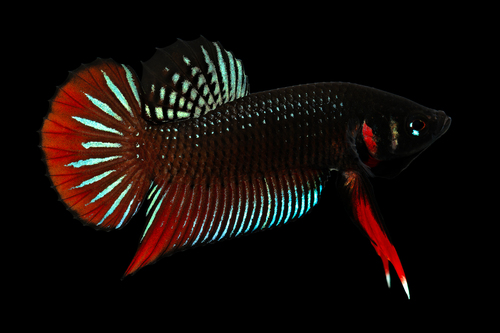
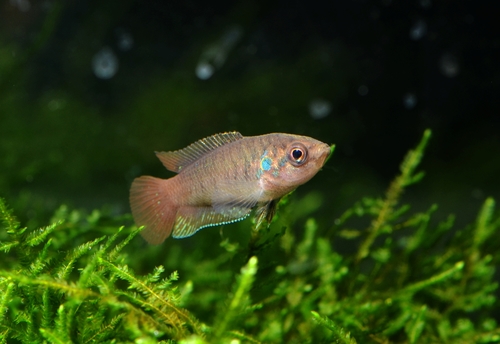
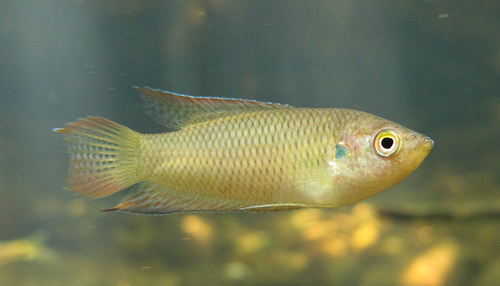
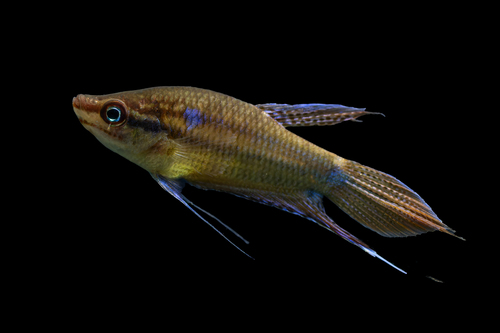
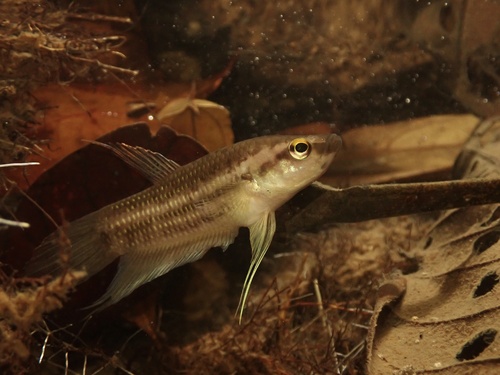
The Penang betta, scientifically named Betta pugnax (Cantor, 1849), has several key physical traits that set it apart from other members of the betta family. Like many species in the betta genus, it has a superior mouth, and it also has a larger than average head. Other distinguishing features include a stouter body, a distinct chin bar, visible transverse bars on the dorsal fin, red subdistal bands and black edges around the anal fins, and no dark edge on the caudal fin. When viewed from above, the head is rhombic in shape, and the irises do not have iridescent patches. The pectoral fins are rounded, while the dorsal, pelvic, and caudal fins are lanceolate. Compared to nest-building betta species, the Penang betta has a duller overall coloration: individuals are typically brown, with green or blue iridescent spots on their scales. Their coloration can shift when they detect a rival or their own reflection in a mirror. Males have iridescent scales covering the operculum that occasionally extend down to the stomach, while females and juveniles have two dark diagonal bands across the body outlined in light brown. These two dark bands meet at the base of the caudal peduncle, forming a distinct spot. Juvenile B. pugnax are more slender than adults, with proportionally larger eyes. B. pugnax is native to the Malaysian island of Penang, where it was once popular as a pet. Its range extends beyond Malaysia into southern Thailand, Singapore, and Indonesia and its archipelagos. Within Malaysia, the species has expanded its range; it is the most common Osphronemidae species found in Malaysian lotic habitats, with established populations in Johor, Kedah, Pahang, Perak, Selangor, and Terengganu. In Singapore, the Penang betta has a wide distribution within Bukit Timah Nature Reserve (BTNR), and it prefers swamps along the reserve's eastern boundary. Researchers found the species in all six surveyed streams and ponds in the reserve, classifying it as the most abundant native fish species, with an average of more than 10 individuals recorded per sampling session. It was the most common anabantoid in forested areas, and it is the only fish species present in small interior streams of Bukit Timah Nature Reserve. The species is also common in small streams and swamps within Singapore's Central Catchment Nature Reserve; the only suspected introduction is recorded at Bukit Brown. The Penang betta typically inhabits hilly and forest streams with clear water. Water current in its habitat can range from sluggish to rapid, but habitats usually have sandy bottoms with rocks and no submerged vegetation. The species tends to aggregate near overhanging bank vegetation, submerged leaf litter, and exposed roots from bank vegetation. It was the only freshwater fish species recorded in two BTNR streams that had slightly acidic water (pH 4.28–4.78), a muddy streambed, and low dissolved oxygen levels, conditions that are generally unfavorable for most native fish. Penang betta breeding size varies based on location. Individuals from Penang start breeding when they reach over 40 mm standard length, while populations from Johor and Singapore can begin breeding before reaching 40 mm SL. A correlation between size and sexual maturity is suspected, but has not been fully studied. The betta family has two primary forms of offspring care: bubble nesting and mouthbrooding; the Penang betta is a mouthbrooder. Females either lay eggs in a depression on the substrate, or spawn eggs directly into the male's cupped anal fin. In the latter spawning method, the female then takes the eggs into her mouth and spits them to the male. Males incubate the eggs inside their mouths for a period ranging from two days to four weeks. After four weeks, hatched eggs become fry and are able to leave the male's mouth. There is a noted correlation between the amount of yolk inside the embryo and the length of post-departure parental care: if embryos have less yolk, fry hatch earlier, and parents will allow fry to return to the mouth for protection during danger or at night for several days or weeks after the fry first leave. Mouthbrooding is an evolutionary adaptation thought to have originated from the habit of placing eggs orally into a bubble nest. It is hypothesized that mouthbrooding evolved either because the species lives in water that is too turbulent for building bubble nests, or because males began retaining eggs after failing to place them into bubble nests. Contrary to common belief, the Penang betta is not inherently territorial during breeding season. There is recorded evidence of interspecies cohabitation in southern Thailand, where B. pugnax lives alongside B. imbellis and B. ferox.