About Berthellina edwardsii (Vayssière, 1897)
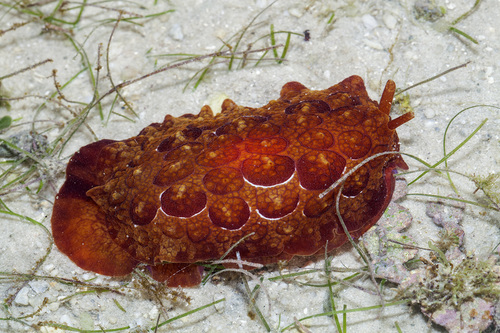
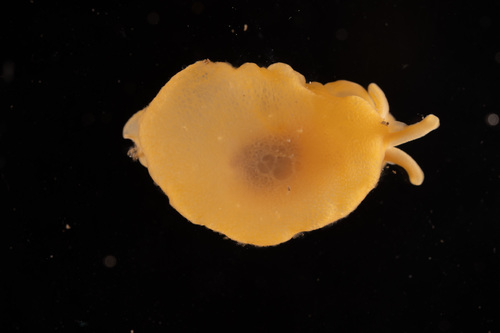
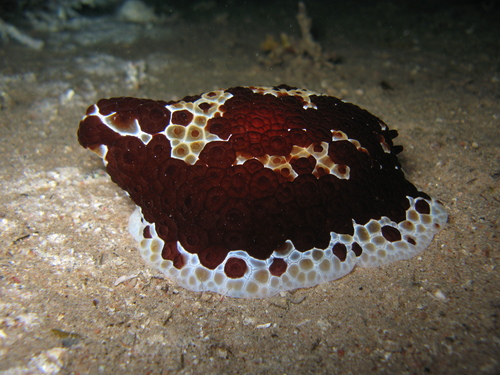
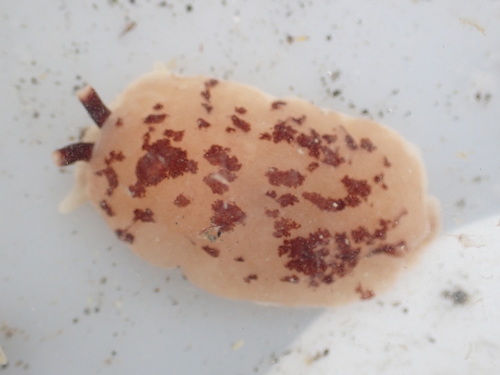
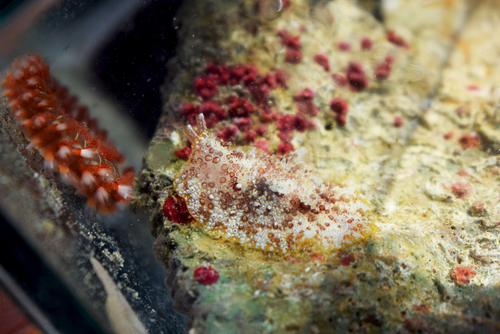
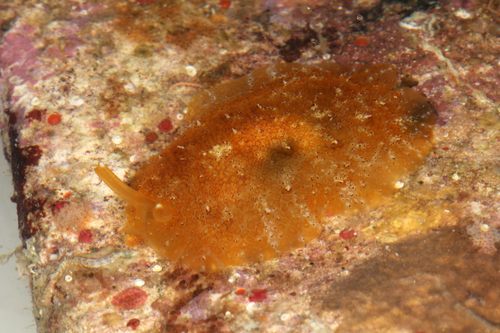
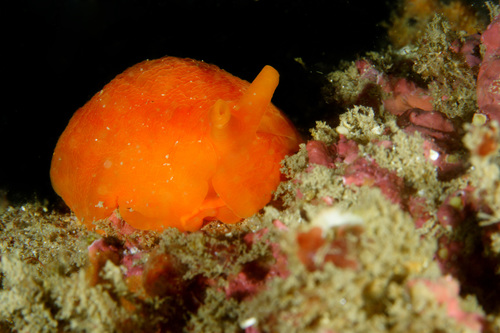
Berthellina edwardsii is a large sea slug that reaches 5 to 6 cm (2.0 to 2.4 in) in length. A pair of smooth, rolled rhinophores sits on top of its head, while its triangular buccal veil and a pair of low-lying tentacles are much less easy to distinguish. This species has a small, flattened internal shell that appears whitish when seen through the slug's translucent body tissue, and dark spots from the digestive glands are visible through its dorsal surface. The foot is broad, and the gill is positioned on the right side of the body, between the foot and the mantle. Its body colour ranges from whitish or lemon yellow to deep orange-red. This sea slug is very similar in appearance to Berthella aurantiaca, and no distinctive external features separate the two; however, B. aurantiaca has a much larger internal shell. Another similar species is Berthella stellata, which is smaller than B. edwardsii, is transparent or whitish, and has a star-shaped opaque pattern on the centre of its back. Berthellina edwardsii is mainly nocturnal, hiding in cracks or under rocks during the day. Glands on its mantle secrete a white acidic fluid that is distasteful to fish, and the slug's bright colouring acts as a warning of its toxicity to potential predators. It feeds mostly on sponges and tunicates, rasping their surfaces with fine teeth located on its radula. Breeding occurs in the autumn. Each individual is a hermaphrodite, and mating pairs position themselves to bring their genital openings close together to exchange sperm. The species produces numerous very small eggs, which are laid in a whitish, coiled cylindrical, jelly-like ribbon that adheres to the underwater substrate.