About Berthellina citrina (Rüppell & Leuckart, 1828)
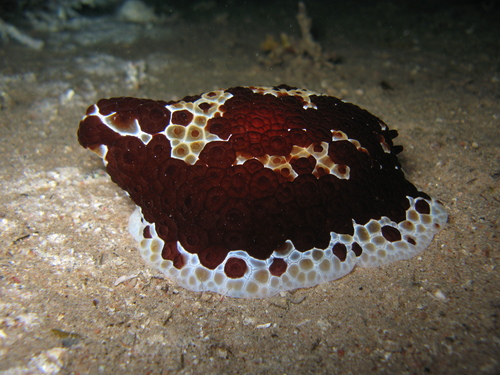
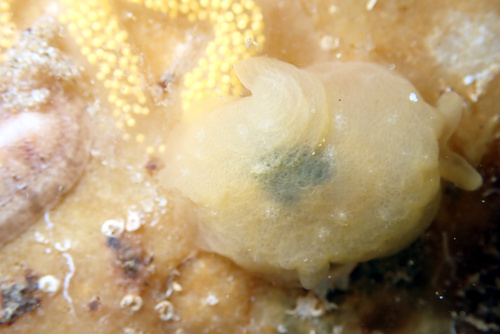
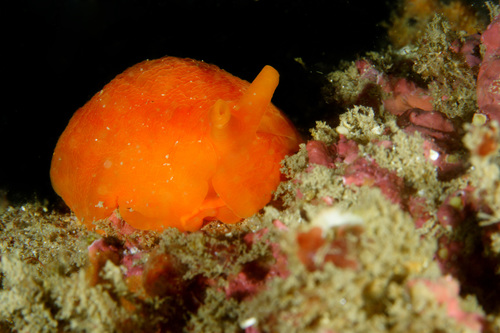
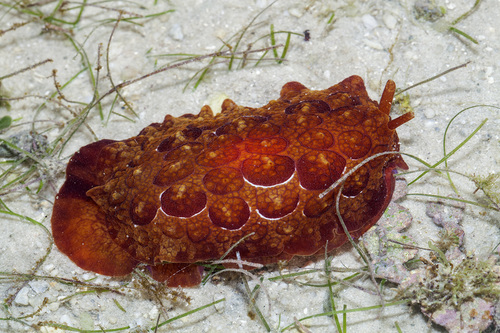
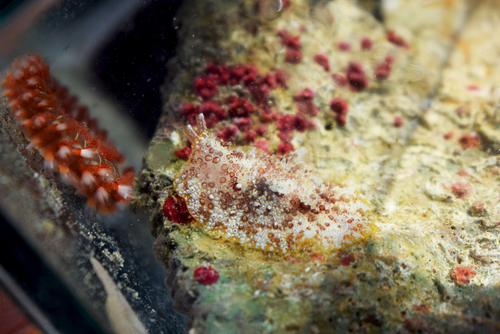
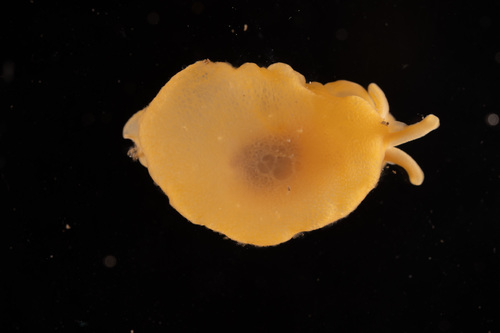
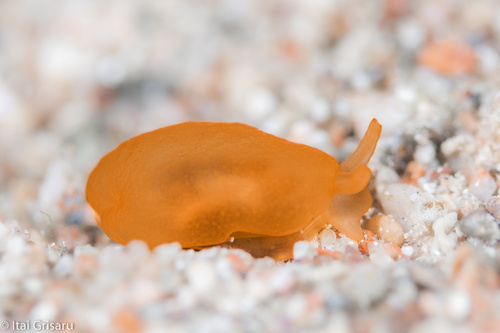
Berthellina citrina (Rüppell & Leuckart, 1828) reaches a maximum length of about 3 cm (1.2 in), with a broadly ovate body. Its colour ranges from translucent pale yellow to brick red. On its head, it has a triangular oral veil with a ventral groove, plus a pair of rhinophores rolled into tubes. The mantle surface is covered in small white glands that produce a distasteful whitish secretion. Remnants of a shell are embedded in the mantle, and the gut can be seen through the overlying tissues. A single gill sits in a gap between the mantle and foot on the right side, with roughly twenty pectinate lamellae on each side of the gill. This is a common species that lives throughout the tropical and subtropical Indo-Pacific, ranging as far south as New Zealand. It can be found in rock pools, on reefs, and among boulders in the shallow subtidal zone, and it occurs down to a maximum depth of 150 m (500 ft). It is nocturnal, and hides in crevices and under rocks during the day. Most sea slugs in this family feed on sponges, and Berthellina citrina follows this diet, though in Hawaii it has been observed feeding on the corals Tubastrea coccinea, Leptastrea sp. and Porites lobata, and it also eats detritus. The glandular secretion is released when the mantle surface is stimulated. It is acidic, contains chlorine and sulphate ions, and acts as a defense against predators; in laboratory experiments, it repelled sea anemones, fish, and crustaceans. Sea slugs in the Pleurobranchidae family are hermaphrodites. Berthellina citrina lays its eggs in an orange spiral jelly-like egg ribbon.