About Beroe ovata Bruguière, 1789
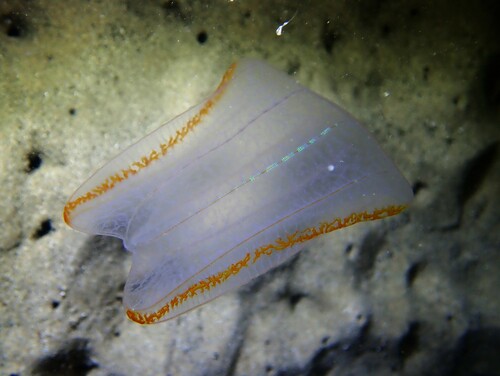
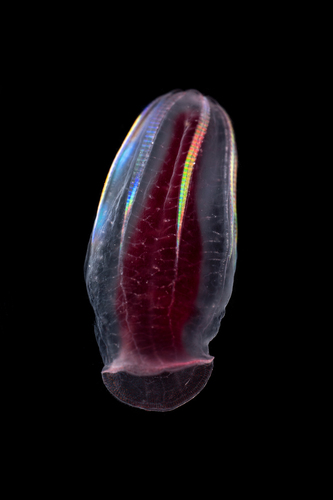
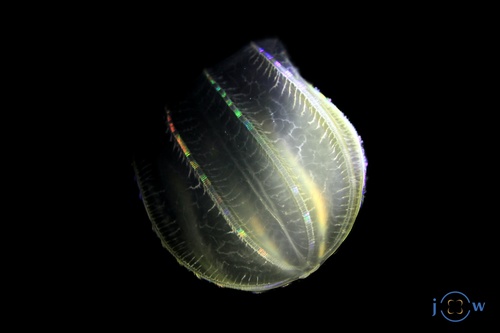
Beroe ovata grows to a total length of about 16 cm (6 in). It is roughly oval or cylindrical in shape, but may be flattened like a mitten or deformed. At one end, called the oral end, it has a large mouth, while the opposite aboral end holds a statocyst, a sensory structure that helps the animal maintain equilibrium. Its body wall is made of a gelatinous mesoglea layer sandwiched between two cell layers. The body is translucent, and is pale blue, or sometimes pale pink in color. On its outer surface, eight longitudinal rows of cilia form structures called "combs"; when these cilia beat in unison, they propel the comb jelly through the water. Beroe ovata usually travels with its mouth forward, but it can reverse its direction of movement. This comb jelly species has no tentacles. Its internal gastric cavity connects to a network of canals that form a meshwork within the mesoglea.
Beroe ovata is a pelagic species with a wide native distribution in the Atlantic Ocean and Mediterranean Sea. It is found in the southern Atlantic off the coasts of both Africa and Brazil, and has been observed in the northwestern Atlantic as far north as New Brunswick and the Chesapeake Bay. Its typical depth limit is around 100 m (328 ft), though it has been recorded at a depth of 1,719 m (5,640 ft). It has been introduced to multiple seas in Eastern Europe, including the Black Sea, the Aegean Sea, the Sea of Azov, and the Caspian Sea. This species has a high tolerance for a wide range of salinities, from 1.2% in the Caspian Sea to 3.3–3.7% at the surface of the Atlantic Ocean.