About Berkheya carlinopsis Welw. ex O.Hoffm.
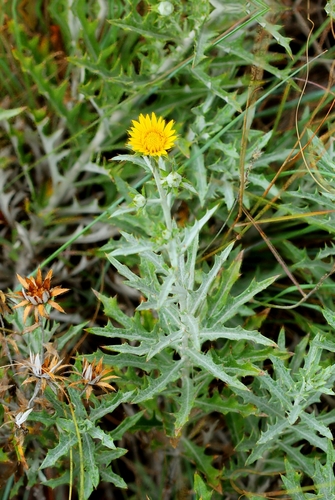
Berkheya carlinopsis Welw. ex O.Hoffm. is a Southern African plant in the family Asteraceae, first published in 1896 in Boletim da Sociedade Broteriana 13: 34. It is a perennial herb or subshrub that grows to roughly 1.5 meters tall. Its stems are leafy, branched, and either covered in whitish spiderweb-like hairs or becoming hairless with age. Leaves are stalkless, ranging from 3 to 6 centimeters long, with shapes from toothed to pinnatifid-dentate. The leaf blade, excluding teeth or lobes, measures 2 to 3 (up to 4) millimeters wide and linear, or 5 to 15 millimeters wide and lanceolate. Each side of the leaf bears 3 to 8 teeth; individual teeth are 2 to 6 (up to 10) millimeters long, triangular or linear, and end in a 2 to 3 millimeter long tawny spine. The margins of the teeth and the gaps between them are either smooth or bear smaller spines. The upper leaf surface is either smooth or somewhat rough, and ranges from lightly to densely covered in spiderweb-like hairs, or becoming hairless with age. The lower leaf surface is covered in a whitish felt-like layer of hairs. Its radiate flower heads are solitary and terminal on branches, or arranged in a loose subcorymbose cluster, with a diameter of 2.5 to 5 centimeters (or larger, the exact maximum size is unclear) when including the ray florets. The phyllaries (involucral bracts) are spreading, covered in felt-like hairs on their outer surface, and either partially hairless or fully hairless on their inner surface. They measure 10 to 20 millimeters long by 1 to 3 millimeters wide, are linear-lanceolate, and end in a spiny point. Their margins are fringed with spines 1 to 3 millimeters long. The outermost phyllaries are somewhat leaf-like, with small spine-tipped teeth. The inner phyllaries are smaller and have fewer spines along their margins. The margins of the receptacle pits are extended into 1 to 2 millimeter long straw-colored bristles. The achenes (dry fruits) are 1.5 to 3.5 millimeters long, turbinate (shaped like a top), have 8 to 10 ribs, are covered in fine appressed hairs, and are glandular and sticky at the apex. The pappus is made of scales arranged in two rows, 1 to 1.5 millimeters long, narrowly oblong, with either pointed or somewhat blunt tips, and finely toothed near the apex. The genus Berkheya was described by German botanist Jakob Friedrich Ehrhart in 1788, named in honor of Dutch botanist Johannes le Francq van Berkhey (1729–1812). The specific epithet carlinopsis refers to Carlina, a genus that closely resembles Berkheya.