About Beringraja binoculata (Girard, 1855)
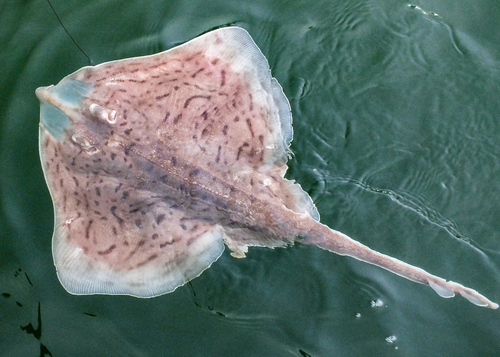
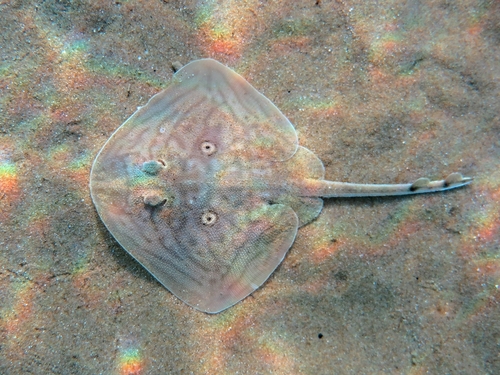
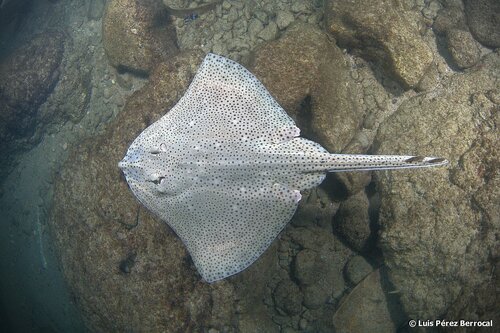
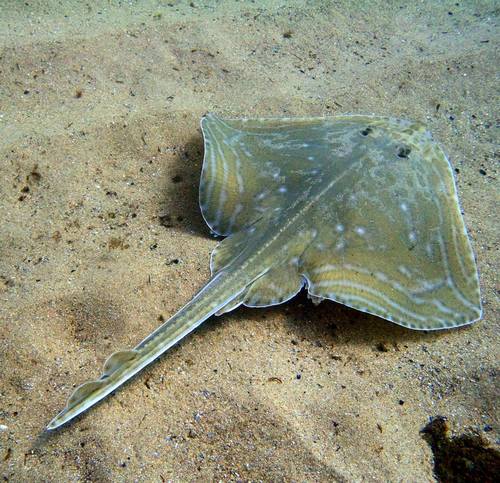
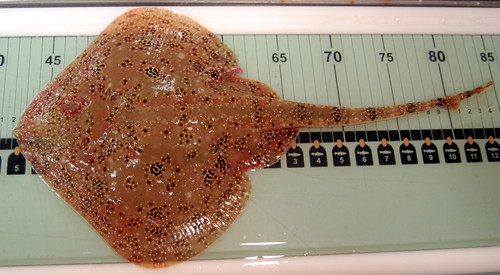
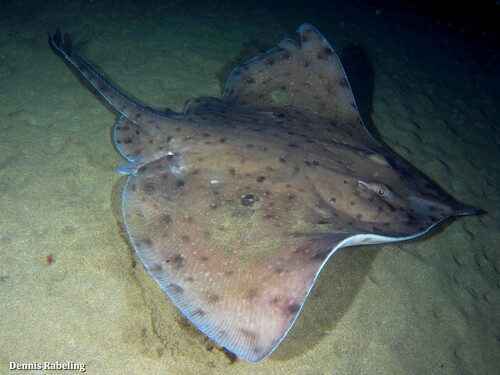
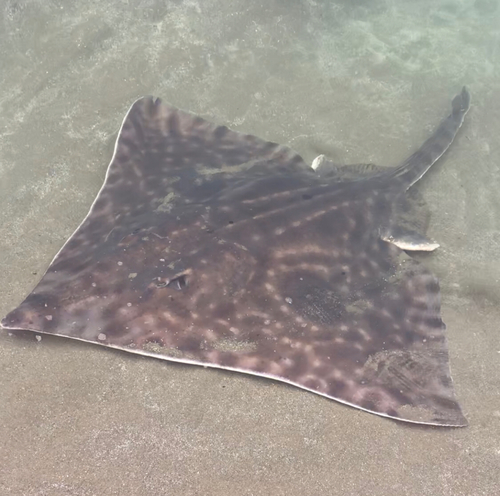
Beringraja binoculata, commonly known as the big skate, has a maximum recorded length of 2.4 m (7.9 ft), though most individuals do not grow larger than 1.8 m (5.9 ft) and 91 kg (201 lb). It has a flattened, diamond-shaped pectoral fin disk that is slightly wider than it is long, with a long, moderately pointed snout. Its small eyes sit just in front of large spiracles. The teeth are small with raised cusps, arranged in 24–48 rows in the upper jaw and 22–45 rows in the lower jaw. Two small dorsal fins are located on the tail, the anal fin is absent, and the caudal fin is reduced to a simple fold. Each pelvic fin has a weak notch. Similar to the Atlantic clearnose skate (Rostroraja eglanteria), the snout area of the big skate is semi-transparent. Juvenile big skates have smooth skin, while adults have small prickles on their dorsal surface, the underside of the snout, between the gill slits, and on the abdominal region. There are two or three thorns along the middle of the back, a row of 12–55 (most often 13–17) thorns along the tail's midline, and one interdorsal thorn. Some older individuals have a thorn above each eye. The back is mottled brown, reddish brown, olive-brown, or gray, marked with rosettes of small white spots or scattered dark blotches. One large dark spot with a pale border is present on each pectoral fin (wing). The ventral side is white, sometimes with dark spots or blotches.
In terms of distribution and habitat, the big skate is found in the northeastern Pacific Ocean, ranging from the eastern Bering Sea and Aleutian Islands south to Cedros Island off central Baja California. It is rare south of Point Conception, California. It inhabits coastal bays, estuaries, and areas over the continental shelf, and is most commonly found on sandy or muddy bottoms, though it occasionally occurs on low kelp strands. While it has been recorded at depths up to 800 m (2,600 ft), it usually lives at depths no greater than 120 m (390 ft). It occupies progressively shallower water in the northern parts of its range. This species is abundant off British Columbia, where it prefers depths of 26–33 m (85–108 ft) and water temperatures between 7.6–9.4 °C (45.7–48.9 °F).
As for biology and ecology, big skates are most often seen buried in sediment with only their eyes exposed. They feed on polychaete worms, molluscs, crustaceans, and small benthic fishes. Polychaetes and molluscs make up a slightly larger portion of the diet for younger individuals. A confirmed predator of the big skate is the broadnose sevengill shark (Notorhynchus cepedianus); the eyespots on the skate's wings are thought to act as decoys to confuse predators. Juvenile northern elephant seals (Mirounga angustirostris) are known to eat the big skate's egg cases. A documented parasite of the big skate is the copepod Lepeophtheirus cuneifer.
This species is oviparous, and it is one of the few skate species that typically holds more than one embryo inside each egg capsule, which are often called "mermaid's purses" when found washed up on beaches. The big skate's egg capsule is the largest of any skate, measuring 23–31 cm (9–12 in) long and 11–19 cm (4–7 in) wide. Each capsule is oblong, with a strongly arched dorsal surface, an almost flat ventral surface, and parallel lateral edges that become somewhat concave toward the center of the capsule. Four blunt, broad horns extend from the capsule's corners, with the posterior pair slightly longer than the anterior. A single egg capsule can hold 1 to 7 eggs, most often 3 or 4. Females deposit eggs in pairs on sandy or muddy flats; there is no distinct breeding season, and egg-laying happens year-round. Females may use specific spawning beds, as large numbers of egg cases have been found in certain concentrated areas. Young big skates hatch after 9 months and measure 18–23 cm (7–9 in) at emergence. Females reach sexual maturity at 1.3–1.4 m (4 ft 3 in – 4 ft 7 in) long and 12–13 years old, while males mature at 0.9–1.1 m (2 ft 11 in – 3 ft 7 in) long and 7–8 years old. Growth rates of big skates in the Gulf of Alaska are similar to those off California, but differ from growth rates recorded off British Columbia. Big skates off Alaska have lifespans up to 15 years, while those off British Columbia can live up to 26 years.