About Bergerocactus emoryi (Engelm.) Britton & Rose
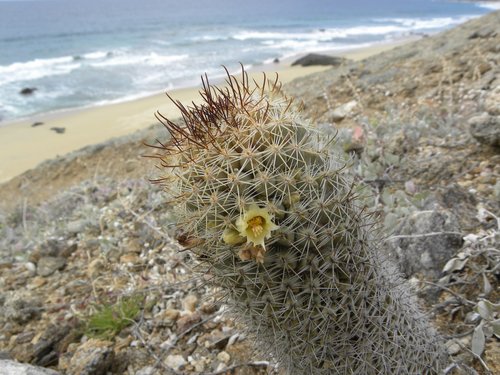
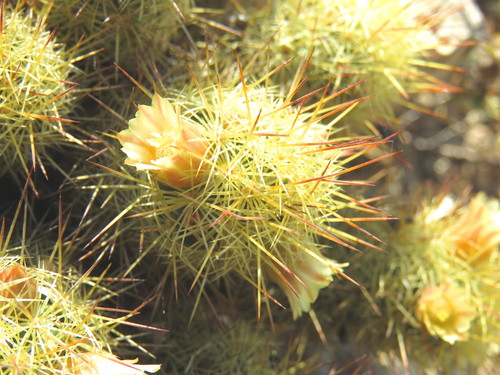
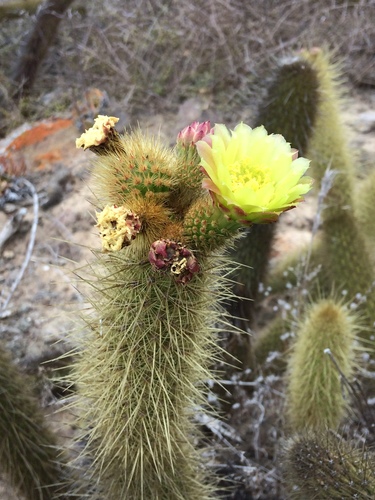
Bergerocactus emoryi (Engelm.) Britton & Rose is a shrub-like cactus that grows into thickets made up of stems that range from columnar to prostrate in shape. When backlit by the sun, its whole colony has a velvety visual appearance. Individual stems are typically less than 2 metres (6.6 ft) long, with a diameter of 3–6 cm (1.2–2.4 in), and are covered in many interlaced, yellow, needle-like spines. Stems are cylindrical, with between 12 and 18 ribs. Each areole holds 30 to 45 spines, most of which are less than 2 mm (0.079 in) in diameter. There are 1 to 3 central spines per areole, which curve downward; the longest of these central spines is less than 6 cm (2.4 in). The radial spines of this cactus are straight. Flowers grow either along the sides of stems or at the stem apex, emerging from the distal edge of the spine cluster. Each flower is 3.5–5 cm (1.4–2.0 in) long and 2.5–4 cm (0.98–1.57 in) in diameter. The ovary is hairless and covered densely with spines. Outer perianth parts are yellow, with roughly red tips and green midveins, while all inner perianth parts are solid yellow. After flowering, the cactus produces a reddish, spherical fruit covered in dense spines, which pushes seeds and pulp out through its tip. The seeds are 3 mm (0.12 in) across, shiny, and black. This cactus is near-endemic to Baja California, with additional populations on Santa Catalina Island, San Clemente Island, and San Diego, California. It grows at elevations ranging from 30 to roughly 60 meters. The remaining populations in San Diego are disjunct, and restricted to protected areas: Border Field State Park, Torrey Pines State Park, and Cabrillo National Monument, as urban development in San Diego has pushed many native species into these protected enclaves. Other rare species that share these San Diego maritime succulent scrub habitats include Rosa minutifolia, Aesculus parryi, Echinocereus ferreirianus, Cochemiea dioica, Cylindropuntia prolifera, Cylindropuntia cholla, Opuntia oricola, Shaw's Agave, Torrey Pine, Tapertip liveforever, cliff spurge, and San Diego barrel cactus. In addition to urban development, this species is threatened by overcollecting and grazing from feral goats. Populations of the species exist on two of the southern California Channel Islands. On San Clemente Island, the golden cactus grows on rocky canyon walls. In Baja California, its range extends from the US-Mexico border south through succulent scrub habitat to El Rosario, and it also grows on many islands off the Baja California coast. However, climate change and other human-caused impacts threaten these island populations. On Isla San Martin, a volcanic island in San Quintin Bay, only one single clump of this cactus remains.