About Bergenia crassifolia (L.) Fritsch
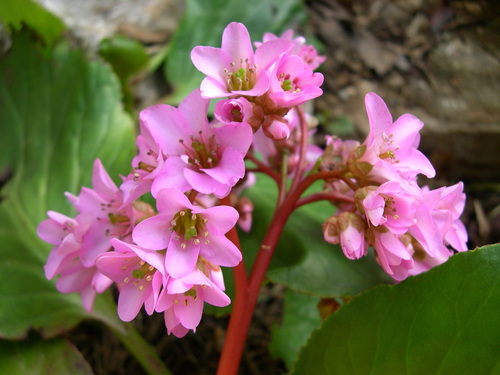
Bergenia crassifolia (L.) Fritsch grows to approximately 30 cm (12 inches) tall. In warmer climates, its leaves are winter hardy, and change color in shades ranging from rust brown to brown-red; the dark green leaves in its basal rosette typically redden by autumn. It has a creeping, fleshy, thick rhizome that can reach several meters in length and 3.5 cm in diameter. The rhizome is highly branched with numerous root lobes, sits near the soil surface, and extends into a strong vertical root. Its thick, leafless stem is pink-red, glabrous, and grows 15 to 50 cm high. Leaves form a dense basal wintering rosette that overwinters under snow. Each leaf has a broadly elliptical to nearly rounded blade that is rounded or chordate at the base, with obtuse or indistinctly toothed edges. Blades measure 3–35 cm long and 2.5–30 cm wide, attached to wide petioles that do not exceed the blade length. The base of each petiole bears membranous vaginal stipules, and a membranous leaf sheath persists for two to three years. This species is a widely cultivated garden ornamental plant, and has been grown in cultivation for landscaping since the mid-18th century. It is used in landscaping for stone gardens, and in grouped plantings among shrubs and trees. Gardeners have developed multiple cultivars with different flower colors, including Bergenia cordifolia 'Purpurea', Bergenia cordifolia 'Winterglut', Bergenia cordifolia 'Senior', and Bergenia crassifolia 'Autumn Red'. It primarily reproduces vegetatively via rhizome segments, though sexual reproduction by seed is also possible. It prefers semi-shady to shady locations with moderately dry, fertile soil, and is typically propagated by dividing bushes in the fall. In its native range of Siberia, Altay, and Mongolia, it is used as a tea substitute. Rhizomes are the most commonly used plant part for medicinal purposes. Rhizomes are harvested by hand, cleaned, washed in cold running water; large rhizomes are cut into long sections. After preliminary drying, they are finished drying in shade or a well-ventilated area, spread in a 5 cm layer over paper or fabric. Leaves are used far less frequently for medicinal use. The species is also used in tanning sole and Russian leather, and for impregnating nets and tarpaulins. Raw material harvested from high mountain areas contains more tannins than material collected in low mountains. This plant's medicinal properties have long been used in Russian folk medicine, as well as in traditional Tibetan and Chinese medicine. Aqueous extracts of the rhizome and leaves are taken internally to treat non-infectious colitis and enterocolitis, tuberculosis, acute and chronic pneumonia, pulmonary hemorrhage, influenza and some other infections, laryngitis, headaches, fevers, articular rheumatism, and gastrointestinal diseases.