About Berberis laurina Thunb.
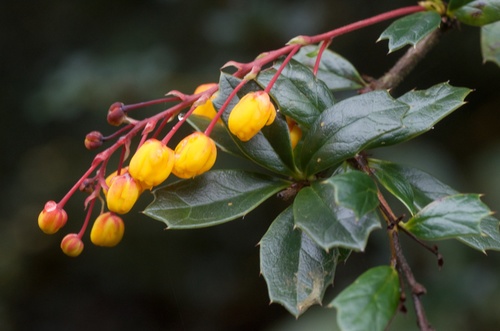
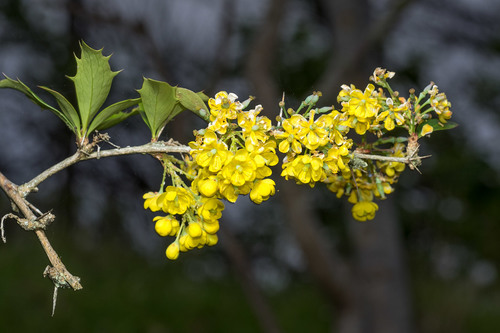
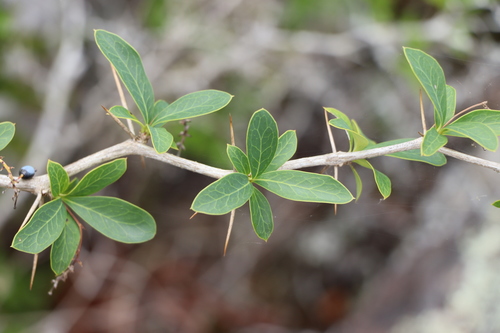
Berberis laurina Thunb. is a spiny, woody shrub that reaches up to 2.5 meters in height. It is evergreen or has semi-persistent foliage. Its leaves are simple, hairless, leathery, and borne on short petioles; they are typically alternate, and sometimes almost arranged in a whorl. The leaf blades are elliptical in shape, 3 to 9 centimeters long, and are sometimes widest past the midpoint of the blade. Leaves have a triangular base, entire margins or margins with a small number of spiny teeth, and end in a spine at the tip. Foliage is bluish green, and may turn yellow or red during autumn and winter. Thorns on the branches are three-parted, reaching around 4 centimeters in length, and have a somewhat yellowish color. The inflorescence is a drooping raceme 6 to 11 centimeters long, with individual flower stalks (pedicels) between 0.5 and 1 centimeter long. Flowers are actinomorphic (star-symmetrical), hermaphrodite, and 4 millimeters in diameter. There is no clear distinction between the calyx and corolla, as both are made up of concave, ovate, light yellow tepals. There are 12 tepals total, arranged in four whorls of three tepals each. Six stamens are positioned opposite the two innermost whorls of tepals. The fruit is a small, oblong bluish-black berry 6 to 8 millimeters long, each containing one to three seeds. This species grows wild in Uruguay, southern Brazil, and Misiones Province, which is located in far eastern Argentina.