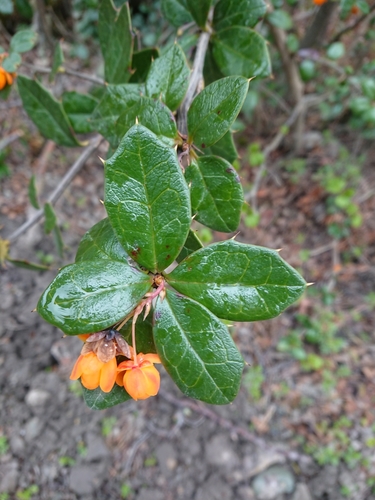
About Berberis ilicifolia L.fil.
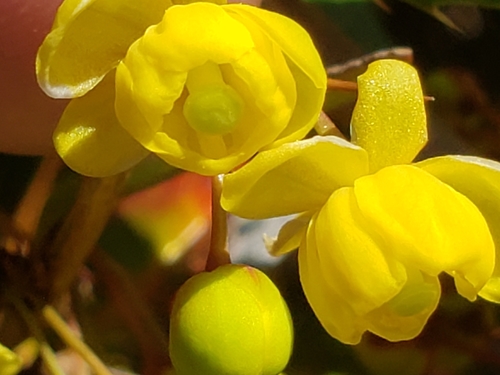
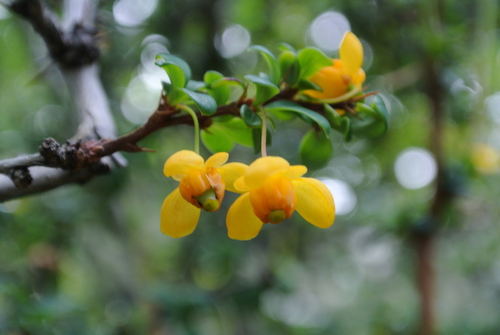
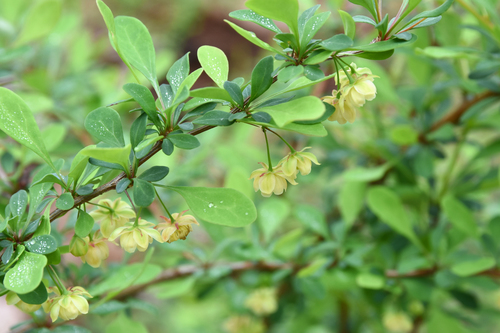
Berberis ilicifolia, commonly called holly barberry, is an evergreen shrub that grows 1 to 4 meters high. When young, its branches are reddish brown, with lengthwise ridges and very fine texture; mature branches become yellowish gray, circular in cross-section, with persistent half-circle-shaped leaf scars, and often develop corky outgrowths. Most spines split into three arms at the base, each 4–12 mm long, and the arms are often somewhat curved outward, sitting almost at a straight angle to each other. Bracts are narrowly triangular and approximately 1 cm long. Leaf blades are roughly elliptic, 20–50 mm long by 12–22 mm wide, with their maximum width located before, at, or beyond the leaf midlength. Leaves are stiff and leathery, with a shiny darker green upper surface that sometimes develops patchy reddish brown or golden discoloration, and a whitish green lower surface. Each leaf margin typically has few spines-tipped teeth per side, ranging from zero to six, most often one to four; each spine at the tooth tip is 1–4 mm long. The leaf tip is either truncated or pointed and spined. The leaf base can be rounded or pointed, and blends more or less smoothly into the leaf stem, which grows up to 4 mm long. The midvein is slightly sunken on the upper leaf surface and protrudes on the lower surface. There are three to five pairs of secondary veins: some extend partially to the leaf margin, while others curve back to connect to adjacent veins. The inflorescence is a raceme holding three to seven flowers, on a common stem 0.7–2 cm long, exceptionally reaching 3.5 cm; individual flower stems are mostly a little shorter than the common inflorescence stem. Flowers are orange, 0.5–1 cm long, with about 14 tepals that change shape from almost circular on the innermost to ovate on the outermost. Filaments are 3 mm long, and unlike many other Berberis species, do not have a tooth on each side; anthers are about 1.5 mm long. Pistils are 3–7 mm long, almost cylindrical, and topped with a stigma approximately 1.5 mm across. After flowering, plants develop spherical, glaucous berries around 1 cm in diameter, which contain four to six seeds each about 0.5 cm long. In ecology, holly barberry grows as part of the understory in Nothofagus pumilio (lenga) and Nothofagus antarctica (ñire) forests, alongside Maytenus magellanica (hard log mayten), Fuchsia magellanica, and the smaller barberry species Berberis microphylla. The filaments are touch-sensitive: they jerk suddenly upright when touched, which showers pollen onto visiting insects. Local inhabitants of Tierra del Fuego have used holly barberry stems to make bows, because the wood is sufficiently pliant and grows in unbranched lengths long enough for this use.