About Berberis glaucocarpa Stapf
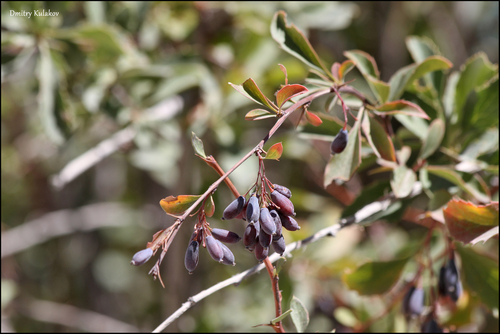
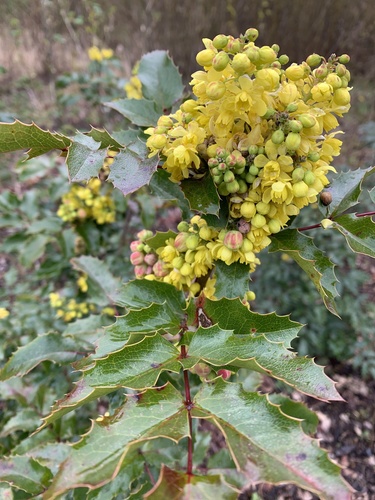
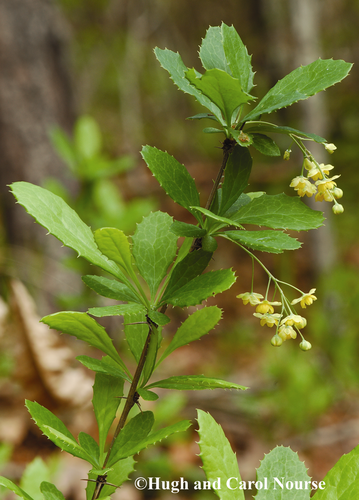
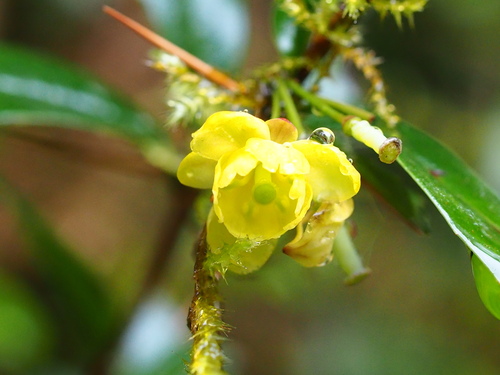
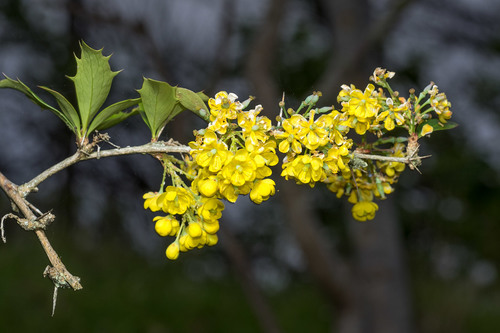
This glabrous, evergreen, woody barberry species is thorny, and can reach a maximum height of 7 metres. Its leaves have short petioles. Flowers are yellow and have a foul odour. Berries are reddish-black or purple, covered in a white powdery coating, and contain dark red juice. It flowers from October to November and fruits until February in New Zealand; in Pakistan, it fruits from September to October. In New Zealand, it can be distinguished from Darwin's barberry (which has dark purple berries) and European barberry (which has red berries). It also has recognisable distinguishing traits: tripartite spines growing up to 2.5cm long, large spiny leaves, and its ability to reach a very large height. This barberry grows in disturbed sites and on forest margins. It was originally introduced as an ornamental plant, and became naturalized in New Zealand in 1916. It has also been recorded in Kashmir, Pakistan. It is sometimes used as a hedge plant. However, it can spread into fields, deter livestock, and may inhibit the growth of native plants. Its fruits are dispersed by birds and mammals, including brush-tailed possums and rodents. In New Zealand, the bird species that most frequently disperse this plant are exotic frugivores: self-introduced Silvereyes from Australia, Song Thrush, Common Blackbird, and Common Starling. New Zealand Bellbirds do not consume this barberry's fruits. The rust fungus Puccinia graminis was found on this species during a study searching for fungal pathogens that could be used to control its spread in New Zealand. Goats will eat this plant when it is no taller than 2m. People in Pakistan eat the fruit of this plant, but only occasionally as a minor food source.